From puppet chefs to Character Studio
October 14–21: connecting design, rigging, motion and custody
The previous entry ended with two chefs and four restaurant props. Over the following week, one question kept returning: can the thing we made survive the next stage without losing what mattered? This timeline records the process, wrong turns and the boundaries of what is actually complete.
Previous entry: bringing puppet chefs into the town →What changed this week?
The current starting point is approved design → mesh and material → own rig and full weights → Bind package → authored motions → Vault custody. Dates below describe decisions at the time. Historical routes are not automatically today’s defaults.
Making different residents belong to the same world
With a baker grandmother, a gardener and a red-haired variation, the question changed from whether a character could be generated to whether repeated results could share proportions and materials. A September wooden-toy boy became the style reference; identity, clothing and expression supplied the variation.
- Workflow
- Character description → style-constrained artwork → shape and material → rig fitted to that body → engine views and a town check. The October 14 baker run took about 35 minutes, including roughly 15 minutes of 3D inference. That is one recorded run, not a service promise.
- Obstacle
- The fitter used then expected arms extending outward and downward, so two horizontal T-pose designs failed. Another variation was refused because its input directory’s latest version moved during production.
- Response and result
- We fixed the design and the fitter’s pose requirements together and reran from a job-owned input copy. Three grandmothers reached the development town; placement still needed inspection, which caught the gardener initially wedged between a house and a fence.
- Still open
- This describes the early pipeline. Later wooden-doll and rigging decisions changed the entry path. Its A-pose requirement, fixed actions and 35-minute timing are not universal defaults.
A fixed body, with a face and clothes that can be adjusted
Generating a new body for every character also generated a new set of surprises. The wooden-doll experiment tried a stable body with interchangeable faces, colours and accessories. It made “something looks wrong” easier to break into specific causes.
- Workflow
- Fix proportions and parts → compare front and side artwork → measure facial features → fit the head and face plate → inspect in Bind → inspect joint bending. Fitted clothing became colour on body parts; accessories with their own silhouette were handled separately.
- Obstacle
- An eight-degree camera elevation was enough to make the face appear too low. Taking whole triangles beyond the intended face window stretched the artwork, and picture coordinates also mirrored it. Separately, rigid one-bone pieces looked right at rest but opened at the joints when posed.
- Response and result
- We leveled the comparison camera, clipped the face window and corrected picture orientation before moving features. Continuous weights across cuts, unified at coincident vertices, replaced rigid seams. Fitted clothes stopped using inflated shells. When a generated cap invented the wrong badge, we built it from the drawings.
- Still open
- Hair, accessories and surface quality still differed. The lesson was to distinguish camera, shape, material and skinning errors. This did not complete a universal modular-character system.
Motion needs separate checks for stride, seams and contact
Text-to-motion made it possible to try walking, jumping and recovery. It also shifted inspection from an attractive pose to continuity across time. Motion Check became its own project on October 16, focused on side-by-side candidates, pausing, frames and comparison.
- Workflow
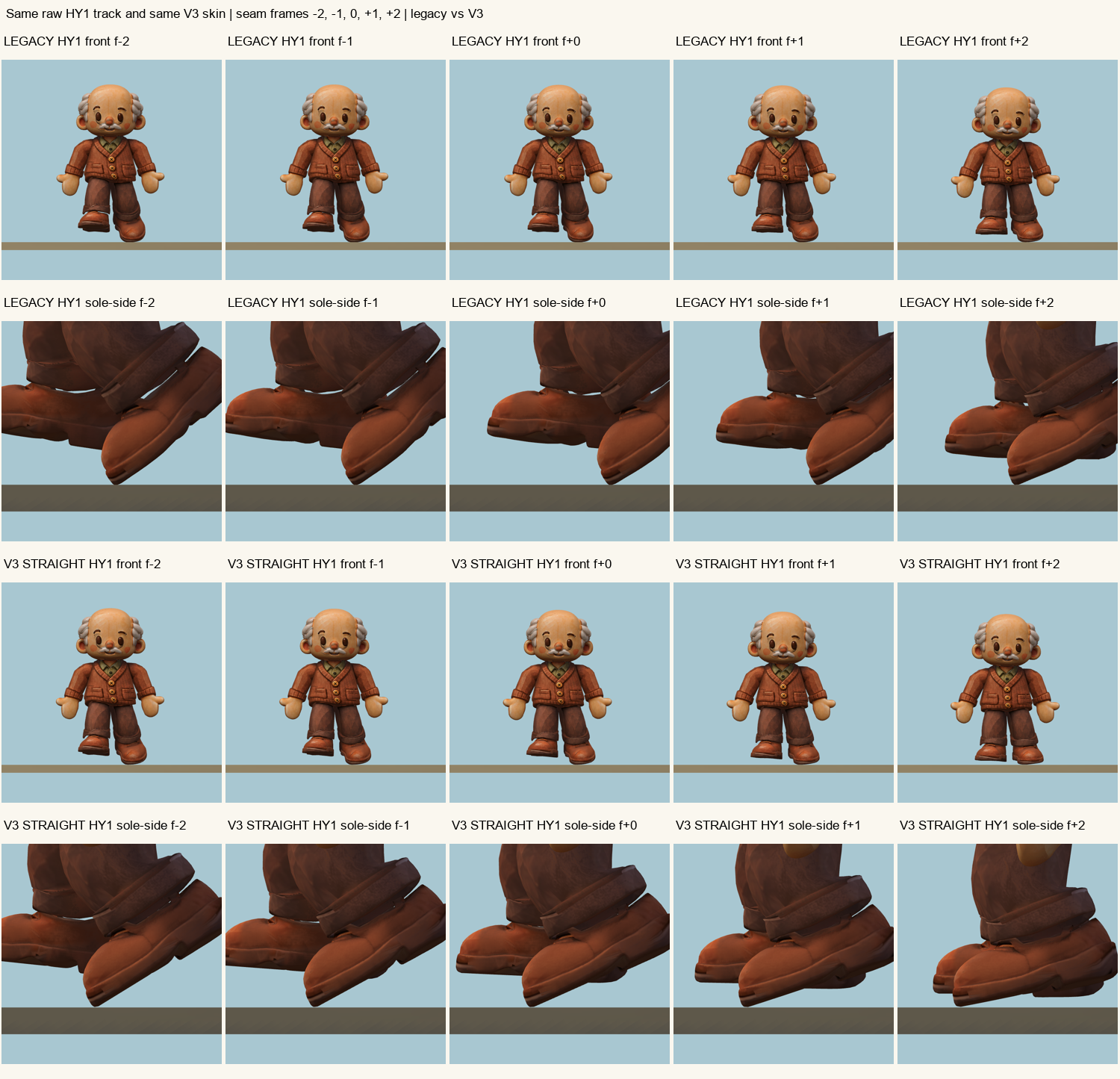
- Original HY-Motion track → retarget to the character’s own bind lengths → choose whether to loop → inspect the boundary → measure the actual skinned soles → compare in the same inspection window. Historical V3 Walk trials kept source motion and skin constant while changing processing.
- Obstacle
- Sliding feet can mean that world travel and stride disagree. A loop can join in position yet jump in velocity. The viewer itself once reset other columns on the primary column’s period, cutting shorter or longer actions incorrectly. A still image cannot reveal these failures.
- Response and result
- World stride was measured per character. Playback gained independent timing and preserved one-shot endpoints. Loop experiments considered both position and velocity; buffer controls previewed before explicit saving. The comparison sheet keeps five frames around the seam rather than selecting one flattering pose.
- Still open
- Historical corrections are not defaults for every new action. Run can still have angular-velocity discontinuities, and crouching can collapse clothing. A passing floor measurement does not prove natural motion, freedom from intersections or cloth physics.
Knowing what each design and production stage actually shows
Hands became an unexpectedly expensive detail. A front view could ask for palms toward the camera while a profile implied another orientation, leaving the generator to reconcile contradictory drawings. Repeated local edits could also pull the character away from its original appeal.
- Workflow
- Approve the overall design → label front, left, back and right → check hands and feet across all four views → bind the exact design hash → obtain human approval for that version → start 3D.
- Obstacle
- A new front cannot quietly reuse old profiles. Rear-view left/right and palm occlusion cannot be inferred from a filename alone. Even a convincing sheet may yield ghost glasses, damaged soles or shorts and skirts that collapse into thin surfaces during motion.
- Response and result
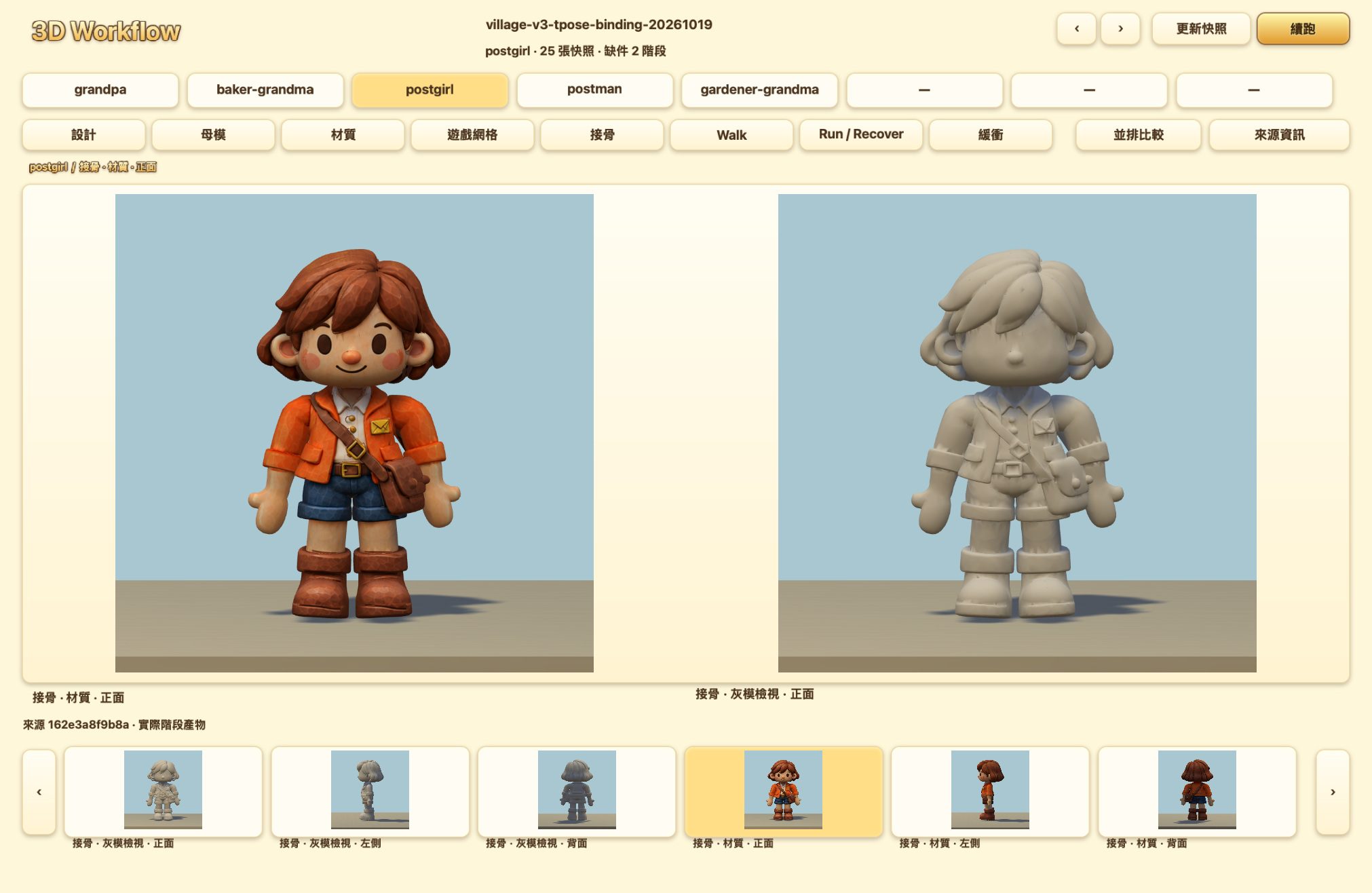
- The native workspace kept real design, material, rig and motion snapshots and displayed missing stages honestly. Five residents supplied 113 source/native snapshots on October 19. Default AI aesthetic voting was also disabled that day; a person approves the current design before production continues.
- Still open
- A clay rendering is a diagnostic of its named mesh, not proof of an earlier source stage. Design approval does not approve the resulting appearance, skinning or play feel.
A separate human route, without forcing every body into 17 bones
Human shoulders, clothing and fingers should not inherit the wooden-doll constraints by accident. This trial separated adult design and rigging: Qwen Turbo produced the design, a confirmed sheet produced a fresh mesh, and AI predicted a hierarchy and weights from that surface.
- Workflow
- Approved four views → fresh unrigged mesh and material → UniRig hierarchy prediction → complete learned weights → GLB and native formats → motion as a separate stage. Keep every predicted joint and valid influence instead of truncating to four weights for an older format.
- Obstacle
- Joint counts and finger branches vary, and names alone are unreliable anatomical evidence. One early result had 52 joints and up to six influences; an A-pose trial had only partial finger branching. Drawing the skeleton is not proof that a closed fist deforms correctly.
- Response and result
- We recorded anatomical recognition, available capabilities and the complete hierarchy separately, and made native playback consume all influence sets. A motion failure preserves the raw rig instead of silently replacing it with the doll skeleton. Manual changes become separate comparison candidates.
- Still open
- Finger animation, clothing and hand–leg intersections still require individual evaluation. Technical rig completion is not approval of the appearance or all future actions.
One workspace for the tools, then a browser entry
When design, mesh, material, rig and animation live in separate tools, even identifying the version on screen becomes work. Integration aimed to make the library, production stages and shared stage agree about which asset was being inspected.
- Workflow
- Select a library character or enter a description → inspect and approve the design → observe real production stages → enter the workbench when complete → compare, inspect and download. Native and Web share the C engine, UI Maker documents and character playback data.
- Obstacle
- The first browser adapter selected the town renderer, giving it different lighting, ground and colour handling from the native studio. Retina resolution and hit targets after resize also needed verification. Account and invitation authority must remain distinct from loading a character.
- Response and result
- The browser gained the corresponding Studio lighting, linear colour, soft shadows and multisampling path. Its welcome page combines the library and prompt form. Motion Studio has a public preview entry; generation requires an invitation. Optional Google sign-in identifies a creator and does not start inference.
- Still open
- Web still differs from the deeper native editing tools, and Metal and WebGL are not pixel-identical. Desktop browser checks do not establish mobile touch performance or acceptance of every generated character.
A character starts in Bind and owns its motions
Bundling six familiar actions such as Idle, Walk and Run made it easy to carry historical corrections into new characters. The newer rule is simpler: deliver the character’s own Bind pose, then author named actions separately.
- Workflow
- Select the character → enter a motion name, English description, duration and loop choice → generate comparison candidates → inspect → explicitly save the action. Character settings keep source tracks, parameters, playback policy and the matching model hash.
- Obstacle
- Calling an action Walk should not silently enable old gait, arm-clearance or landing-buffer settings. Editing a rig should not erase saved action names and provenance either. A material rerun also exposed a stale motion-inventory hash that could make a valid transfer fail.
- Response and result
- The new route preserves the full generated duration and bridges endpoints only when looping is requested. Saving admits the updated character and sources while retaining earlier actions. Lucia’s staged trial separated retexturing too: UltraTex variants were checked for unchanged geometry, rig, weights and Bind bytes.
- Still open
- Lucia’s original back projection was seriously misaligned. UltraTex improved the back and fabric, but collar and finger artifacts remained. Both results contained only Bind. A material comparison is not animation acceptance and did not change everyone’s default material.
Connecting compute and custody without turning a disconnect into another job
The workflow extends beyond the GPU. Lost provenance, a second generation after reconnecting, or cleanup that removes the only completed asset can undo the useful work. These boundaries became explicit receipts and responsibilities.
- Workflow
- Discover paired nodes and capabilities through Phoenix → invoke an available capability on the chosen node → record the original request and receipt → retrieve and verify artifacts → retarget and admit the character → let Vault keep selected contents and retire scratch in the background.
- Obstacle
- An index entry does not mean the bytes are stored. A network timeout does not mean the worker stopped. Guessing an operating system, SSH path or replacement request can select the wrong environment, duplicate GPU work or retrieve the wrong result.
- Response and result
- Vault custody means selected bytes have actually been stored. Producers continue after receiving a receipt rather than waiting for cleanup. The HY motion entry uses a listed Phoenix capability; collection retries observe the same request instead of restarting inference. Phoenix also owns native website HTTP transport while Motion accounts, jobs and Vault keep their existing authority.
- Still open
- This is not a completed global GPU scheduler. Only listed capabilities are supported; current model processes, job owners and admission rules retain their authority. Missing capabilities cause a clear refusal, not an undisclosed fallback.
Making progress visible, and stating what a check cannot prove
By today, the goal has moved beyond producing a final model: the process should be visible, the result retrievable and the next step understandable. Mesh and material previews during production are part of that shift.
- Workflow
- Mesh/material stage completes → publish a fixed checkpoint → client verifies its index, size and hash → display a preview → rigging and skinning continue → verify and admit the final bundle separately. Motion inspection uses the character’s own Bind and hierarchy without editing it.
- Obstacle
- Missing early-stage evidence cannot be recreated from a finished model and presented as history. Correct bone lengths and forward kinematics do not prove ground contact, freedom from intersections or convincing weight. An empty result must never masquerade as a passing check.
- Response and result
- An intermediate preview remains marked running; an oversized attachment is reported as unavailable. Motion reports separate numeric validity, hierarchy, bone lengths and explicitly declared loop seams. Warnings do not silently repair poses. The public studio and native tools share data contracts, while deployment of each tool remains a separate fact.
- Still open
- Next comes comparison of contact, intersections and motion quality against traceable characters and original tracks. This article records saved source and experiments through October 21. It does not present every candidate, native tool or unfinished trial as a production website feature.