Walking into the World We Generated
October 21–23: a town, its motions, and two days of starting over
Last time, character production became a connected workflow. Over the next two days, characters crossed doorways, climbed stairs and met other residents—and several seemingly finished decisions had to be examined again. This entry follows a town we can actually enter, and the tradeoffs involved in making it usable.
Previous: From puppet chefs to Character Studio →From an asset to a place
This account closes with the development state on the evening of October 23: buildings → preview and saving → a walkable community → rollback and measurement → Mira → V4 residents. Native, Simulator and website work have separate delivery states; a merged experiment does not mean every feature is live on the public site.
How far is a house image from a house we can enter?
The previous entry connected designs, meshes, rigs and storage. This time we pulled the camera back and began building somewhere for those characters to live. Red tiles, timber beams and an arched doorway appeared quickly in the concept. Walking up to that doorway exposed a different set of questions.
- Workflow
- Qwen concepts and four views → inspect generated geometry → author native modules → assemble walls, openings, roof and floors → walk through with a real character. The initial native cottage used ten module types and 4,520 triangles including six window instances. Hollow interiors and a two-storey house with traversable stairs followed.
- The obstacle
- Reducing generation cost did not automatically produce a useful building. One coarse-decoder trial produced an 18,812-triangle mother mesh with open edges, fragments and a missing ridge. A smaller mesh still did not answer whether a doorway was passable or a stair opening existed.
- Response and turning point
- That coarse candidate was rejected as a production building recipe. Native .mesh.abyss programs made dimensions, wall thickness, floors and attachment points editable, with C tools producing the geometry. This step was complete only when the character could actually enter and climb the stairs.
- Still open
- The walkable house has explicit limits. Movement uses support surfaces and authored links; it does not establish general physics, free falling or hand contact. The door animation does not constrain articulated fingers to the handle.
Give experiments room to exist—and to be discarded
Character and motion work produces more candidates than keepers. If every attempt becomes a permanent library item, finding the version worth keeping becomes harder. Saving became an explicit creative decision.
- Workflow
- Select a character → describe a motion → observe the original job → compare the preview → explicitly Save. The studio added HY-Motion/MoMask selection and editable prompt examples, while retaining the character, clip and playback position across the workflow.
- The obstacle
- Refreshing the page, losing a transfer and failing generation are different events. Replaying a request can waste inference; permanently saving every temporary result moves the cost of experimentation into the library.
- Response and turning point
- After verified receipt, unsaved browser motion previews live only in RAM and disappear on refresh or close. A character’s temporary editable workspace can remain recoverable within its expiry window; the two have different lifetimes. Save verifies the selected version and admits only the required files.
- Still open
- The tradeoff must be visible: lighter previews and a cleaner library require deliberate saving. A completed or failed job must not restart merely because someone checks its status.
The town comes alive between doorways and stairs
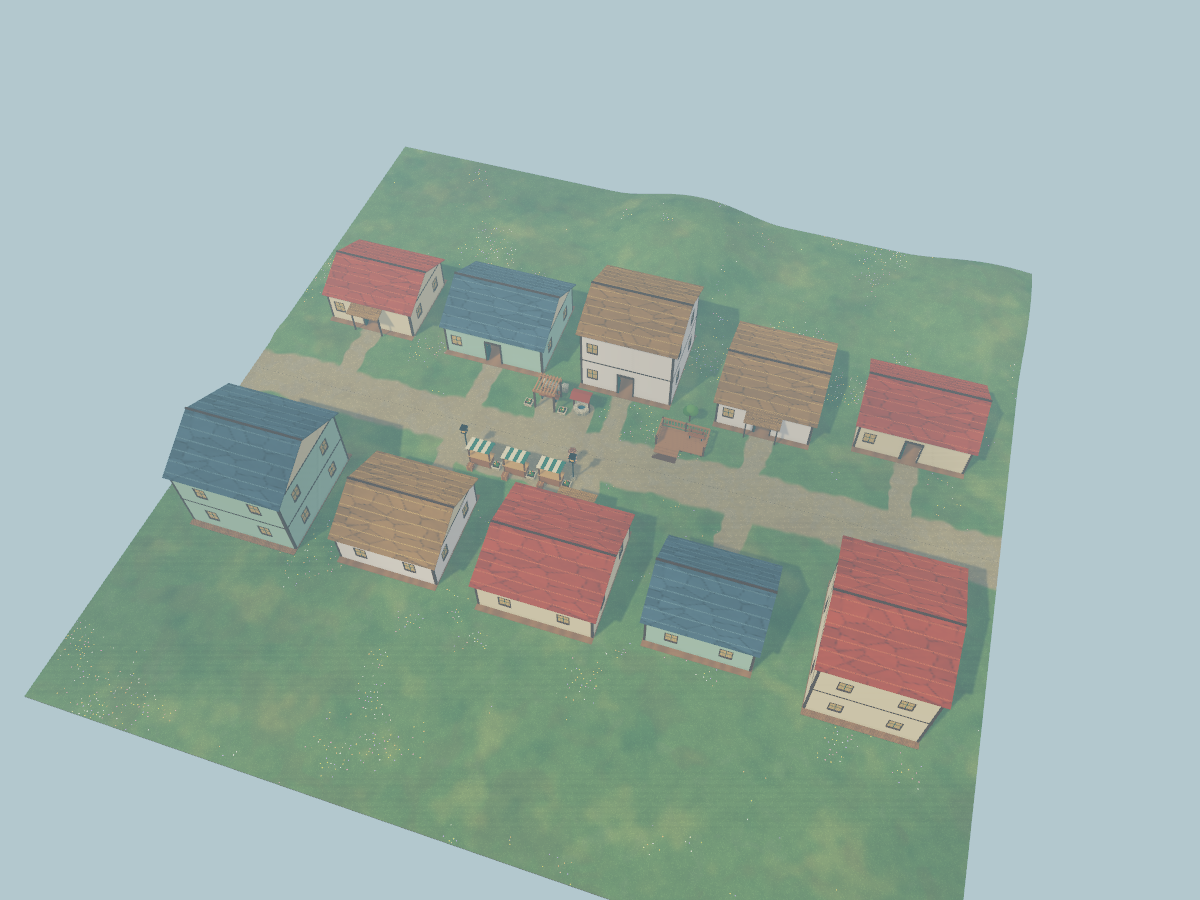
After ten houses were placed, the space began to face everyday use. A table fitting inside a room did not mean someone could reach the chair. A finished-looking garden could still block the entrance. Placement and movement had to be designed together.
- Workflow
- A 64 × 64 metre terrain → ten homes, including three with accessible upper floors → market, well, arbor and raised garden deck → vegetation and 107 furniture pieces → five residents. After the evening V4 recast, the archived package verified 1,244 objects and 63 models.
- The obstacle
- Door lanes, stairs and floor connections must remain clear. Upstairs furniture must not block downstairs movement. Operating a door from inside once sent the character to the outside approach point; held movement could also miss a higher linked floor.
- Response and turning point
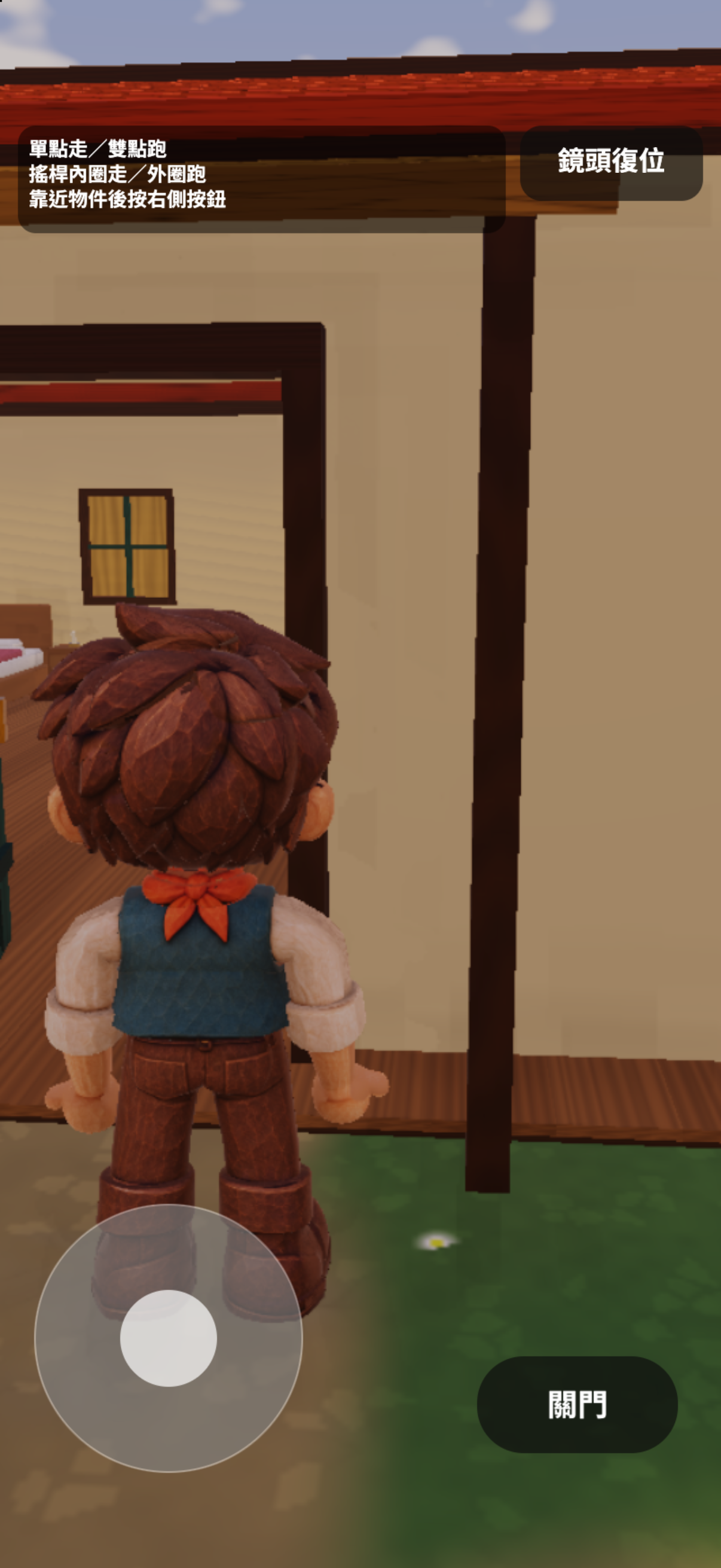
- Furniture is placed from actual room and wall geometry, mirrored when it blocks a route, and omitted if it still cannot fit. Doors choose the approach on the character’s side, and stick movement can cancel an action. Residents wander, rest and step aside for the player. Door, gait and interaction rules remain in .abyss scripts.
- Still open
- Benches, wells and stalls remain scene props; sitting, drawing water and trading are not implemented interactions. An Abyss UI build ran on iPhone. The subsequent shared-Host correction was verified in Simulator and still required a signed device update and human touch acceptance.
Roll back the slowdown, then examine the rules around the work
After jump, dash and camera features were combined, interaction became slower. That integration was rolled back in full so the previously playable version remained available. The next step was to measure smaller pieces. On the same day, the development process itself received a similar examination.
- Workflow
- Keep the baseline → revert the regressing integration → measure picking, routing and terrain queries separately → compare old and new routes → reintroduce narrowly scoped camera collision.
- The obstacle
- Scanning every terrain triangle for each support-height sample made a ground-click action take roughly 612 ms in the Debug scene. Early camera avoidance also scanned the entire scene repeatedly per frame. Separately, a small build could trigger accounting over roughly 400,000 historical artifact files.
- Response and turning point
- A spatial grid restricted terrain queries to local triangles, reducing the ground-click operation to about 16 ms. All 60 seeded route comparisons matched, including routes rejected by both versions. Camera collision first filters object bounds. Build admission retired full-tree capacity inventories and the artificial aggregate quota while retaining per-workspace limits, low-space protection and process guards.
- Still open
- The 612 → 16 ms result is operation latency in that Debug scene, not overall engine FPS or a hardware speed ratio. The reverted jump/dash features are not counted as delivered. Lighter capacity checks also do not mean every cleanup reference scan has disappeared.
Mira: keep “more natural” beside the remaining defects
Mira repeatedly exposed the same problem: an aggregate score could improve while a small shoulder patch collapsed further. Before fitting more weights, we returned to the relationship between the source motion’s palm orientation and the character’s rest pose.
- Workflow
- Same mesh and motions → fixed shoulder, elbow and wrist regions → compare arm references → play native views side by side → treat surface penetration separately → screen each candidate for regressions.
- The obstacle
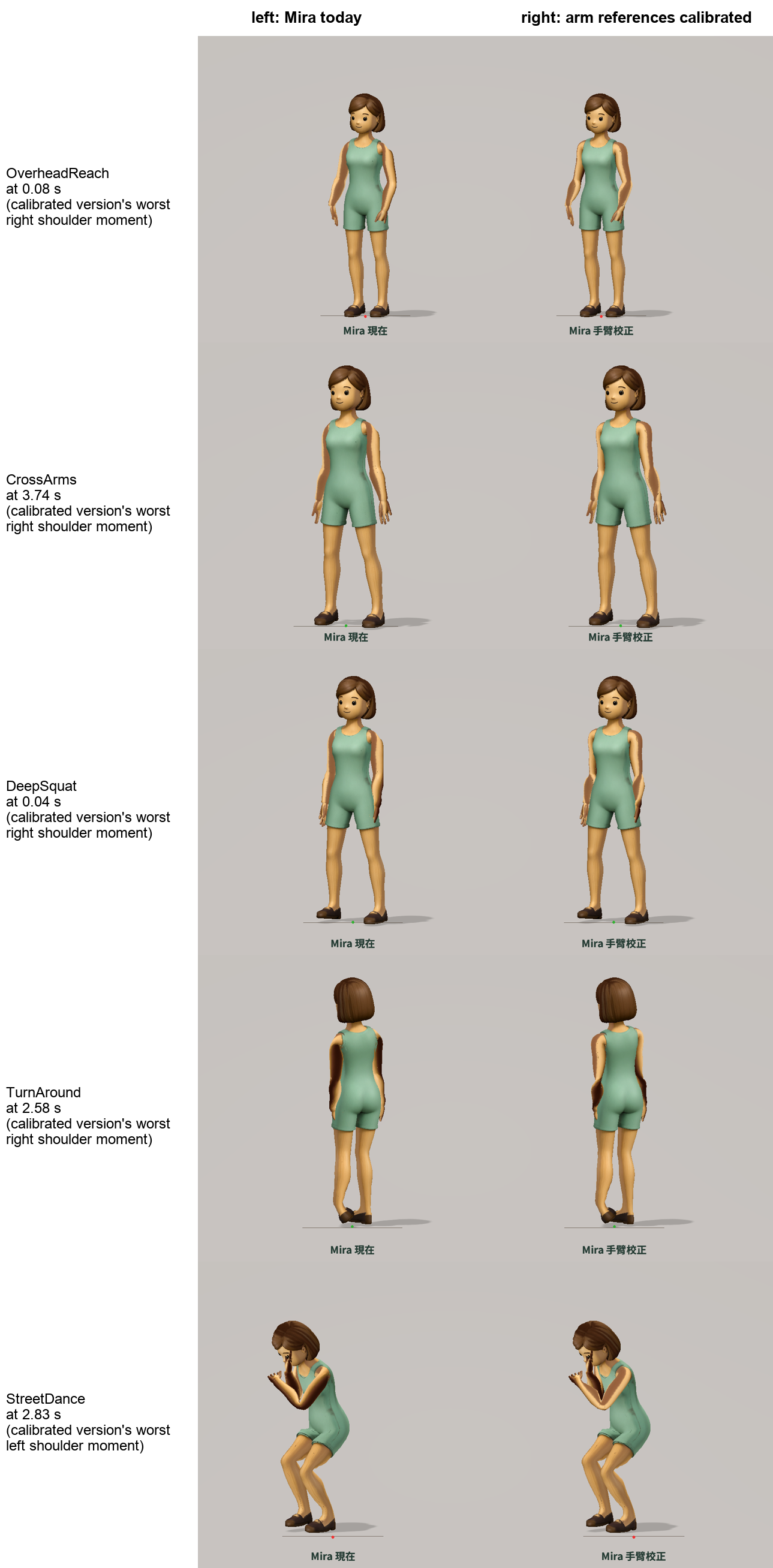
- The source T-pose has palms facing down; a character may have palms facing forward. Applying that whole difference at the shoulder can twist and pinch the upper arm even while standing. Correcting the reference improves much of the surface while some worst-case triangles can still deteriorate.
- Response and turning point
- The upper arm now follows the source rest reference, sharing the palm difference between forearm and wrist. The side-by-side decision was “the right is much more natural.” A separate Walk separation repair reduced measured penetrating surface from 14.1% to 2.8%. The visual decision was “the right is better,” while p95 distortion rose slightly from 1.814 to 1.817. Batch repair therefore uses an explicit small regression allowance and retains the original clip when a candidate fails.
- Still open
- Whole-mesh maximum distortion still increased in 9 of 15 arm-reference runs. Walk received a human visual decision; the other six batch-repaired clips were measured only. A 2.8% result still contains penetration. These sampled surface checks do not establish correct anatomy, cloth or every possible motion.
Five V4 residents return to town, carrying both gains and regressions
This round used each resident’s previous front design as guidance for Qwen Image 2.1 wooden-doll views, then learned a rig and skin from the new model. The baker, gardener, grandpa, postman and postgirl were all recast in the same town so comparisons could continue in one environment.
- Workflow
- Previous front design → Qwen wooden views → mesh and material → individual AI rigs with complete weights → six existing HY motions → native checks → Vault storage → town recast and traversal of all ten doors. These residents have 16–34 bones and up to six skin influences.
- The obstacle
- The baker’s long dress obscured her knees and required explicit bone-role overrides. Mitten-like hands exposed a null palm-normal bug. Arms that hang and swing more naturally also meet the rounded hips and thighs more often.
- Response and turning point
- Run/Jump p95 distortion fell for all five, but Walk penetration increased against V3 and Fall worsened too. Turning the hips out ten degrees reduced an earlier V4 Walk range of roughly 16–26% penetration to about 8–18%, still above V3. Automatic separation candidates for grandpa sank the feet and worsened strain, so all were rejected and the six original clips remained.
- Still open
- V4 is the selected version for continued observation in town. Less distortion in large actions does not imply better walking contact. Appearance and feel still need character-by-character, motion-by-motion judgment; no single score accepts an entire character.
| Resident | V3 | V4 |
|---|---|---|
| Grandpa | 3.2% | 7.6% |
| Baker grandma | 6.3% | 12.3% |
| Postgirl | 4.2% | 14.7% |
| Postman | 3.8% | 15.4% |
| Gardener grandma | 4.8% | 18.2% |
Leave somewhere to return to
These two days produced homes and residents, along with reversions, rejected candidates and deliberate omissions. Together they preserved the ability to return to the same model, motion and route for comparison. Walk through the doorway, look at the shoulder, then decide which changes deserve to stay.