Bringing puppet chefs into the town
Five days of 3D workflow experiments
How far is a charming character drawing from something that can walk around a game? Follow five days of experiments from generated images to puppet chefs and restaurant props—and the points where we had to stop and start again.
From artwork to the engine
Native Mac tools handle authoring, comparison and engine previews; the local GPU on Pop!_OS handles model inference. ComfyUI and Blender are authoring tools, while the C engine handles models and motion at runtime. Characters and static props share the early stages, then branch into rigging or alignment and packaging.
- 01Design artwork
- 02Local 3D inference
- 03Inspect source mesh
- 04Game mesh and material
- 05Rig or align props
- 06Validate in the engine
Each stage leaves a comparable candidate. When appearance fails, return to the source before spending more effort downstream.
Connecting multiple views—and separating generation from cleanup
The starting point was simple: give the model less to invent about the unseen sides of a character. On October 8, we tried existing four-view artwork and a Qwen turnaround through PixelArtistry’s Pixal3D multiview workflow, keeping the original images, crops, dense source mesh and postprocessed output separately.
- Workflow
- Artwork → named view crops, background removal and consistent framing → four-view conditioning → shape and texture inference → dense source mesh → postprocessing, UVs and baking. The Mac handles authoring and native previews; the local GPU on Pop!_OS runs generation.
- Obstacle
- Four illustrations can look like the same person while disagreeing on proportions, hat angles or back details. A separate runner problem also obscured the result: generation had completed, but a one-second wait during process shutdown made the overall job fail.
- Response and result
- We held the mesh and cameras fixed and compared clay, base colour and the full baked output. The dark facial patches survived baking, so missing UVs alone could not explain them. The runner was changed to observe real download, log, output and shutdown progress, record completed generation separately from pending cleanup, and clean only after its own processes had exited.
- Still open
- This established an inspectable execution path, not an accepted character. A successful health check is not evidence that generation is progressing.
Preserving the source surface and its colours
Next, we examined the source mesh itself. If conflicting surface orientation exists before reduction, we need to locate it rather than hope that baking or rigging will conceal it.
- Workflow
- Keep source face and corner correspondence → locate orientation conflicts → split the necessary indexed seams → inspect shape and original colours from fixed cameras in AbyssMeshMetal.
- Obstacle
- Welding every coincident position can reconnect surfaces that should remain separate; rebuilding the whole mesh can alter the face, hair edges and silhouette. Geometric position, connectivity and colour seams are different constraints.
- Response and result
- The experiment kept triangle positions and colours, changing indices and duplicating only the required vertices. Recorded orientation conflicts fell from 3 to 0, and I accepted the displayed source mesh’s shape and original-colour appearance.
- Still open
- The tradeoff was a large number of coincident boundaries. This was a surface-preservation checkpoint, not completed watertight repair, UVs, rigging or a game mesh.
Fewer triangles do not automatically mean a better asset
On the 11th, we continued reducing the accepted source mesh and ran a Blender Collapse control. Fixed framing made it possible to judge actual surface preservation instead of relying on a forgiving distant view.
- Workflow
- Same source mesh → native edge contraction with source-colour and seam constraints → five-view inspection and a topology audit; then an independent Blender Collapse run on that same input.
- Obstacle
- The native route reduced roughly 12.27 million triangles to 5.03 million, then about 4.80 million with local endpoint changes and quadric-error ordering—still far too dense. The Blender control requested 12,000 triangles but produced 960,740, with conspicuous triangular fractures and broken colour patches on the face, clothes and hair.
- Response and result
- We kept the accepted source mesh and recorded the Blender result as a visual rejection. A completed tool run did not make it the default. The next focus became local topology and source-attribute correspondence rather than more global welding or simply forcing a smaller triangle count.
- Still open
- Triangle count, topology and appearance need separate judgments. Not every dark triangle is proven texture dirt or a hole, and individual run times are not a performance ranking.
One shared front image: comparing one view with four
For another multiview trial, we first made the comparison fair: generate a chef turnaround with imagegen, then give both candidates the exact same front crop. The main difference was the three additional views.
- Workflow
- Fix the model, seeds, field of view and 512 shape grid → connect four views in one run and actually disconnect the side/back inputs in the other → compare raw vertex-colour and clay renders before reduction or rigging.
- Obstacle
- Four views better matched the arm profile and apron/back split and reduced large floating pieces. Yet both outputs retained pitting, damaged eyes, hair striping and colour deviations; the four-view scarf also shifted toward green.
- Response and result
- The raw outputs contained 828,360 triangles with four views and 742,512 with one. Extra views helped in specific areas, but neither passed visual acceptance. Multiview remains an opt-in experiment while single-image modeling remains the production baseline.
- Still open
- This tests one versus four inputs to the same multiview model; it does not establish that every single-image backend is worse. A coherent-looking turnaround is not proof of geometric consistency.
Tracing arm spikes to binding and input contracts
The early chef candidates looked plausible at rest but grew long spikes in motion. Fixing the skeleton still left dark facial patches. That forced us to separate deformation problems from the source mesh’s quality.
- Workflow
- Slice the triangle surface → fit 17 joints and weight regions → retarget the existing motion bank to the character’s own bone lengths → produce its contact-body profile → inspect native close-ups, directional input and Jolt scene behavior.
- Obstacle
- The boy’s binding assumed horizontal T-pose arms, while the chefs had lowered A-pose arms. Some lower hand vertices were weighted to the chest or pelvis and stayed behind as the arm turned. Reusing the common skeleton also stretched the torso and legs. Slicing only low-poly vertices missed the body surface between large triangle corners.
- Response and result
- We switched to actual triangle-surface slices, fitted each arm’s centreline and kept shared motion rotations while recomputing positions from the character’s bone lengths. We then used PixelArtistry’s original single-front 01→03 and 02 game exports, obtaining roughly 30,000-triangle candidates with cleaner faces. Feeding the open, nonmanifold four-view mesh directly into 03, which expects a closed mesh, left only fragments; that branch was rejected.
- Still open
- No new motion bank was generated. The Taiwanese chef’s short sleeves still place the shoulder near the sleeve hem. An own-proportion character must currently be the only shared human-body appearance in its scene; mixed proportions in one scene remain unresolved.
Returning to the design: five-head-tall puppet chefs
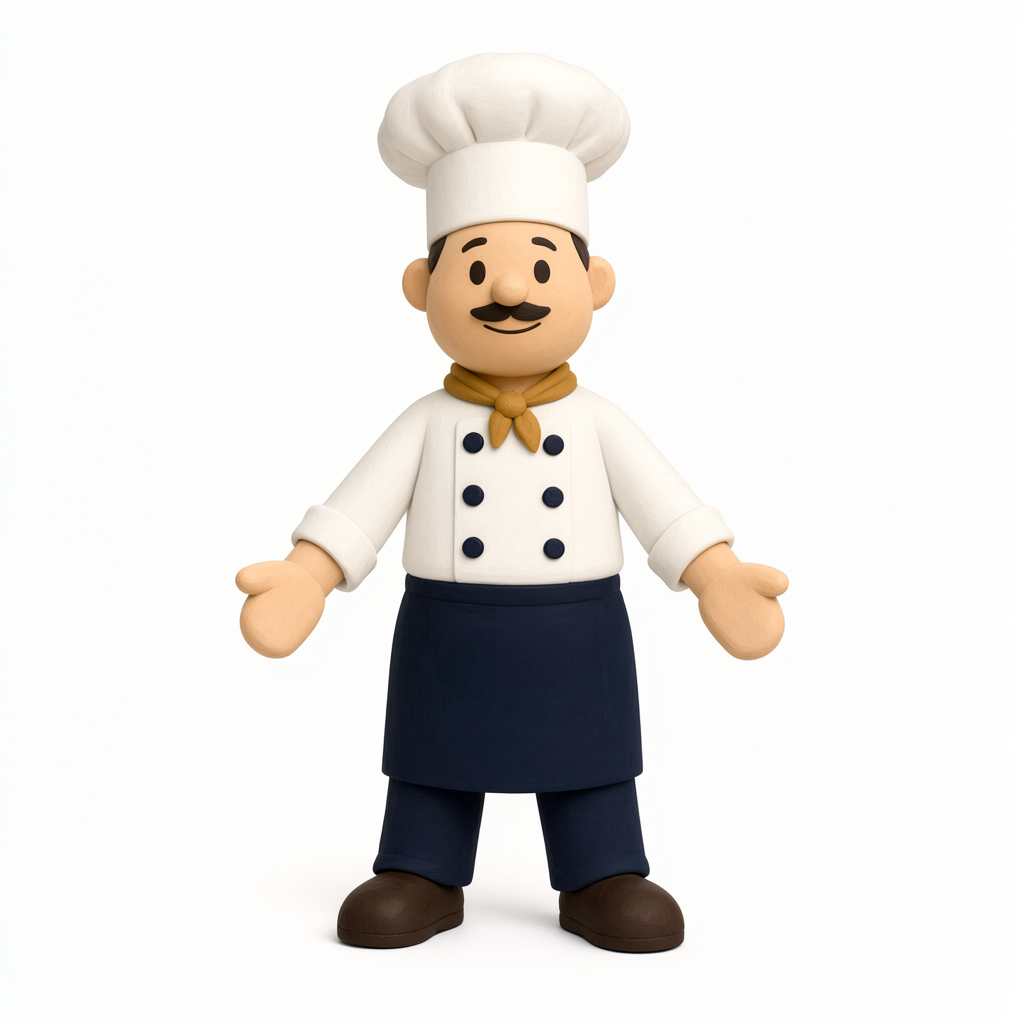
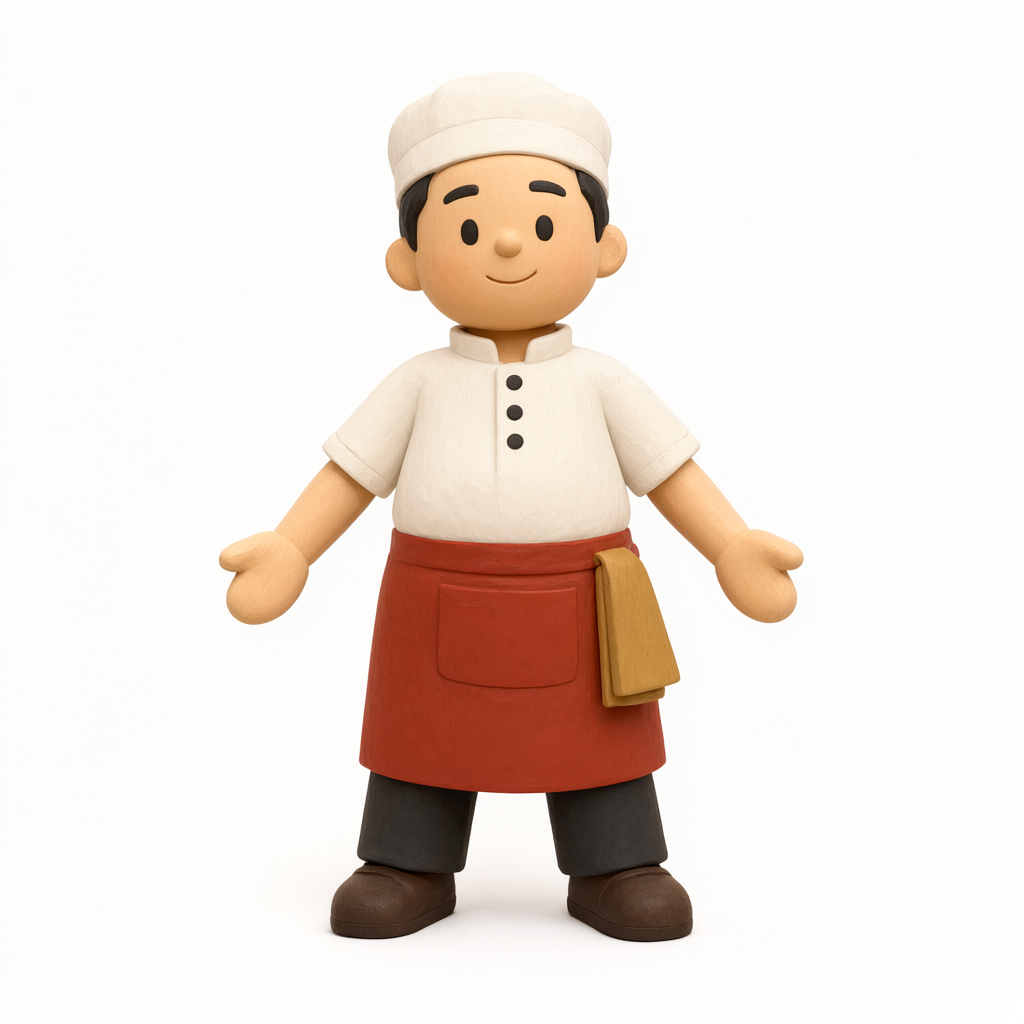
Once the pipeline worked, the original question remained: are these the characters I want? The first chefs lacked the wooden-puppet feel, so we returned to Qwen Image 2.1 and redesigned both as members of one hand-carved, painted wooden family.
- Workflow
- Text design → select French artwork a and Taiwanese artwork b → run each through A (01→03) and B (02) → game mesh → own-proportion binding → native close-ups and town footage. Lowercase a/b identifies artwork choices; uppercase A/B identifies the 3D routes.
- Obstacle
- The prompt needed to specify both style and a workable pose: five-head proportions, a round wooden nose, mitten hands, and A-pose arms lowered about 35 degrees with a gap from the torso. “Cute chef” was too vague, and an attractive front still leaves the back to inference.
- Response and result
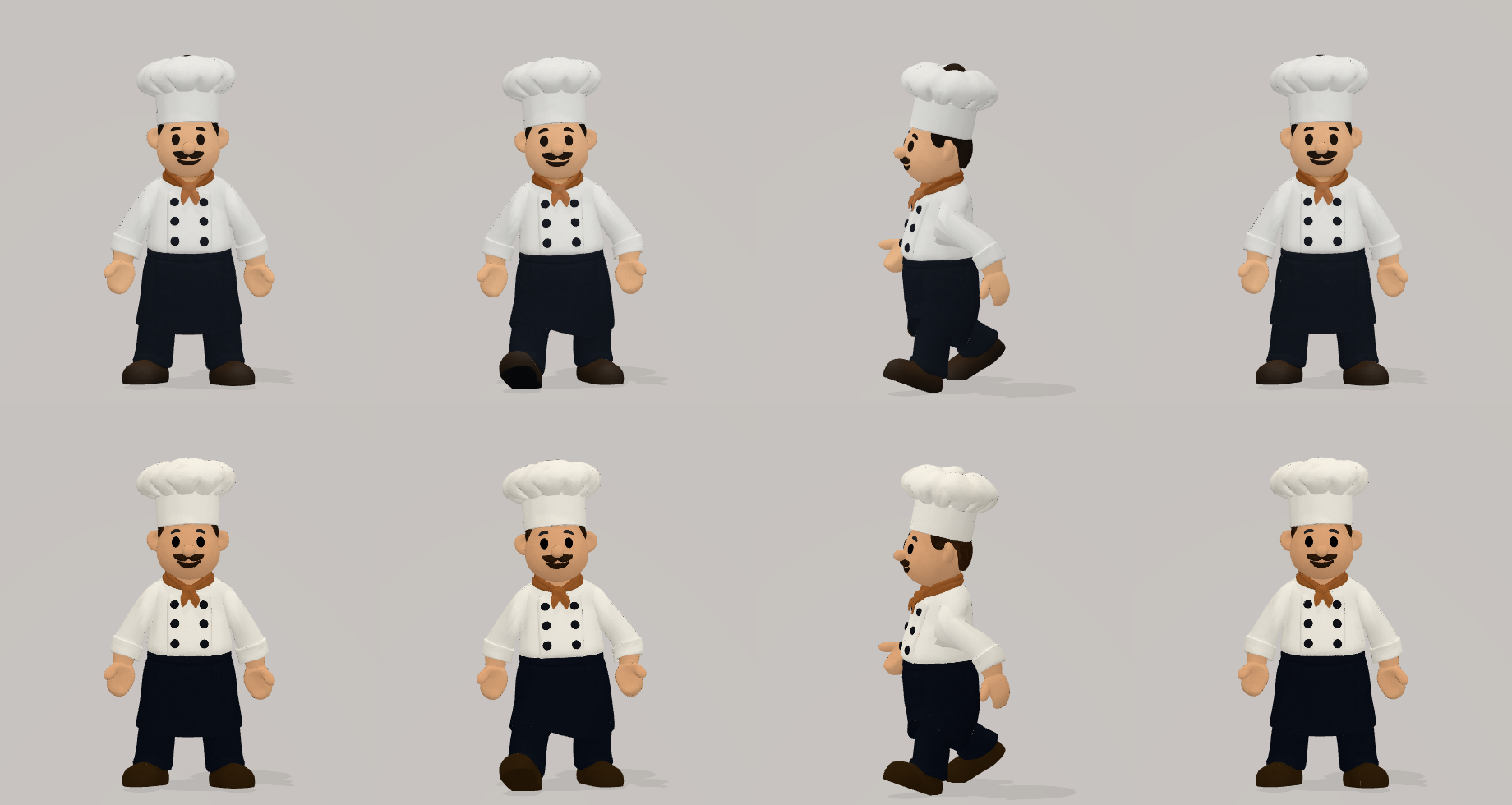
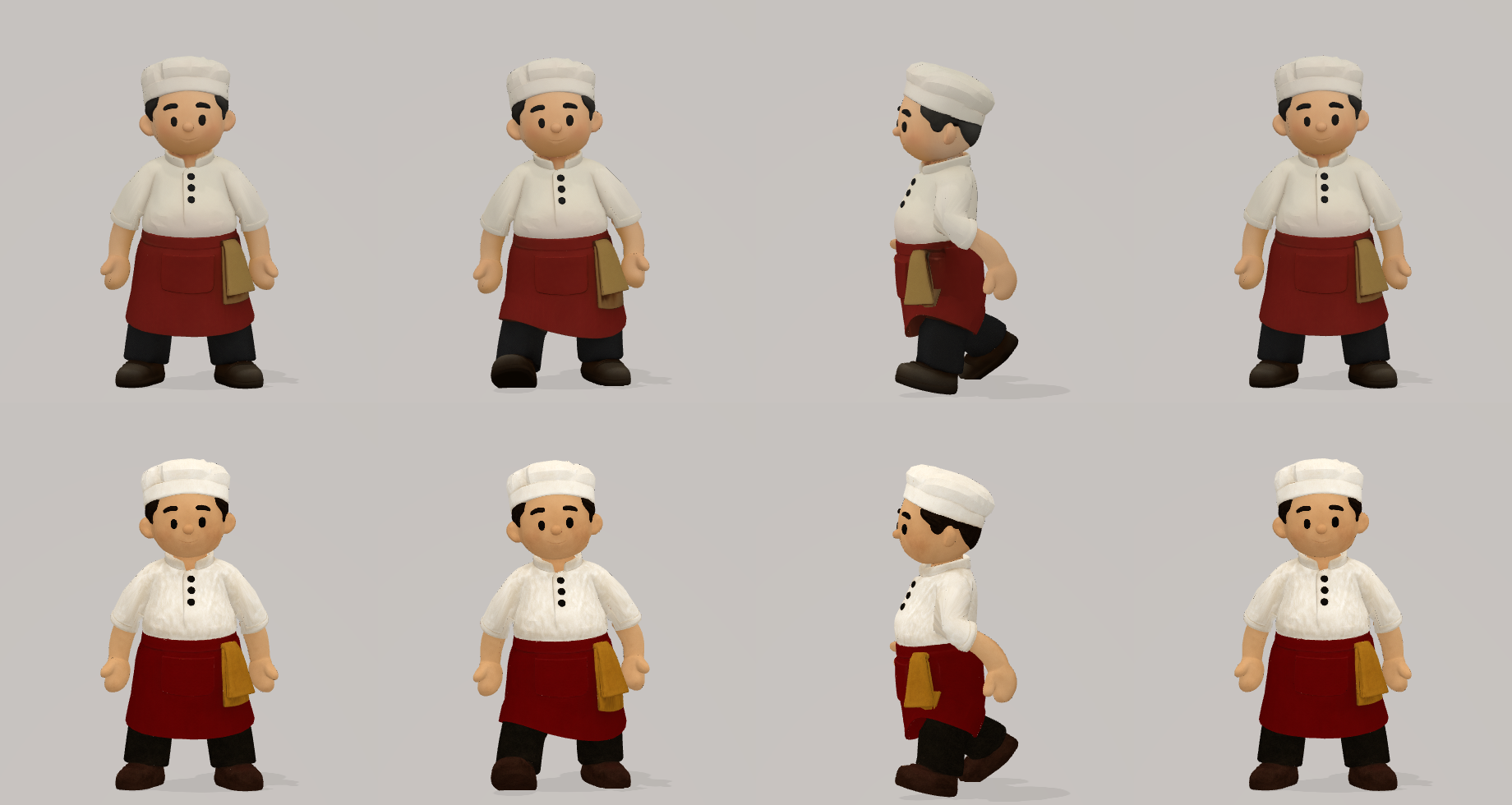
- The four candidates contain about 29,984–30,000 triangles. All passed the directional, walk/run, jump, fall and recovery checks, with no recurrence of the earlier arm spikes in the close-ups. A has a crisper hat edge; B is slightly softer. French A and Taiwanese B are the retained choices. The designs, motion sheets and videos below are the actual outputs.
- Still open
- This is a visual selection, not completed play acceptance. Single-run timings on the shared GPU are affected by other work and cannot establish a speed ranking between the two routes.
Restaurant props: a 4,000-triangle budget and a stubborn crate
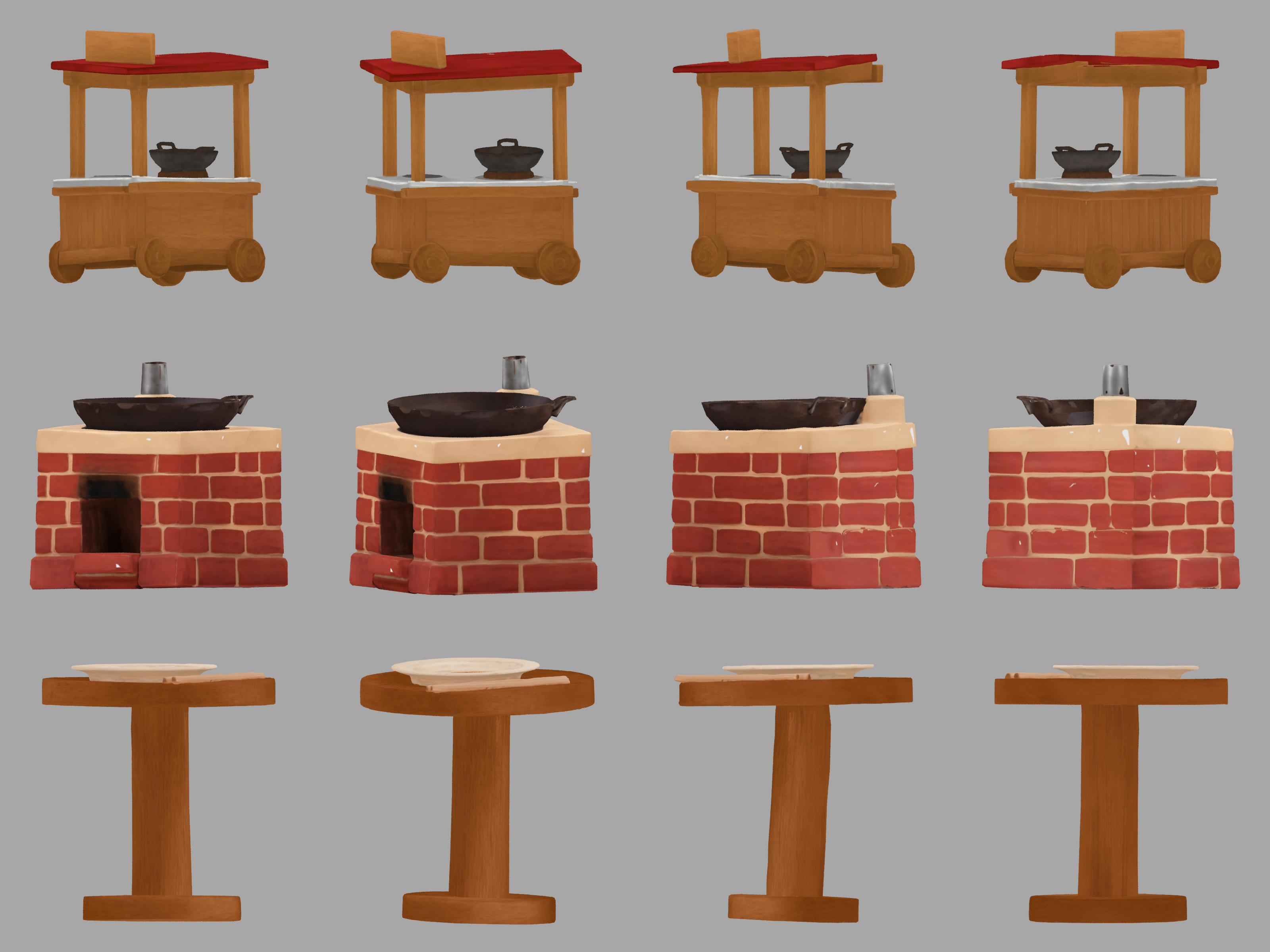
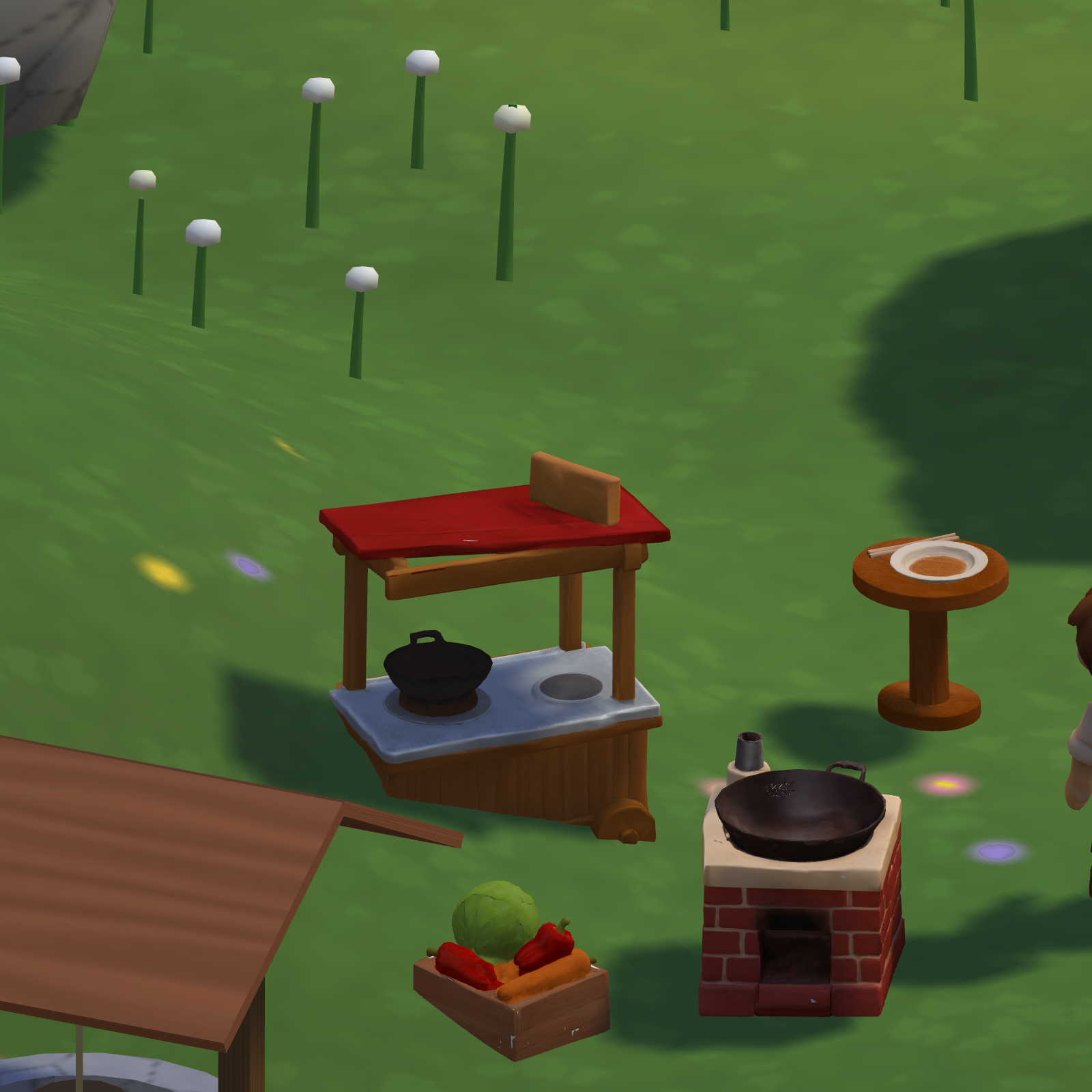
The chefs needed somewhere to work. We tried a stir-fry cart, a brick wok stove, a small round dining table and a vegetable crate, keeping the wooden-toy design language and checking scale and style in a private town copy.
- Workflow
- One Qwen three-quarter-view design → PixelArtistry 02 → set the game-mesh Trimmer target to 4,000 → preserve triangles and UVs while packaging a 1024 base-colour GLB → centre, ground and level it → place it in the native scene.
- Obstacle
- The elevated design view made objects lean toward the camera; the table tilted about 23.5 degrees. A slatted crate filled with small vegetables failed five times through crashes, a polling timeout and out-of-memory errors on the 16 GB GPU. One intermediate watertight mesh approached 60 million faces.
- Response and result
- We estimated the base direction from the area-weighted normals of large downward-facing surfaces and rotated the props upright. Redesigning the crate with solid sides and a few large vegetables let the same recipe complete; reducing a later dense-mesh budget had not fixed the bake failure. Final meshes contain 3,972–3,998 triangles. Replacing the full 4096 PBR set with the game’s 1024 base colour brings each GLB to about 1.48–1.63 MB.
- Still open
- Leveling assumes genuinely horizontal undersides in the design, and the crate still has small upstream texture specks. These props are not in the production scene and have no collision bounds, interaction or LOD; their backs are still inferred from one image.
| Prop | Triangles | Export → game GLB |
|---|---|---|
| Stir-fry cart | 3,972 | 92.2 → 1.59 MB |
| Wok stove | 3,998 | 87.1 → 1.63 MB |
| Dining table | 3,998 | 79.1 → 1.48 MB |
| Solid crate | 3,990 | 87.5 → 1.56 MB |
Most of the file-size change comes from the material choice, not lossless compression of the complete PBR set. The native package currently uses base colour.
What this round delivers, and what comes next
These five days produced a repeatable authoring process that preserves inputs and candidates and brings them back into the actual engine for inspection. The two retained chefs, four scene props, and ongoing multiview and surface-preservation branches each have their own validation boundary.
- Workflow
- Record artwork, recipes, seeds and hashes → use private job outputs and storage budgets → compare source, game mesh and native renders from matching views → run mechanism checks → make human visual and play decisions → remove unnecessary temporary output.
- Obstacle
- The hardest boundary is between finishing a job and producing something usable. An exported mesh may violate the next stage’s closed-surface requirement; a passing rig check says little about feel; placing a prop does not make it interactive.
- Response and result
- We record generation, cleanup, mechanism verification, visual selection and play acceptance separately. Next come better shoulder deformation and coexistence of different body proportions, then collision and interaction for the props—so a chef can actually walk up to the cart and work.
- Still open
- This article records this round of experiments as of October 12, 2026. The town currently playable on the website remains the existing release and does not include these chefs or props.