Three Apps on a Database: a Messenger, a Tool, a Plant Diary
Round fifteen: three agents build three desktop apps with the engine alone, each with its own SQLite database; three AI jurors' scores, and three versions you can open
The rounds so far built web pages. This time I wanted apps: a messenger, a tool and a lifestyle app, with a database from the start. Three agents each built a desktop app in a 1280 × 800 window, as in every round with only the engine's UI documents, .abyss flows and its MCP, and not a line of C. The same three jurors looked them over and were blunt: competent, consistent and professional-looking, but none would yet be chosen over the leader of its category, and the weakness they share is ambition. I take that.
Previous: Toon Lines on the Town, Footprints in the Snow →From pages to apps
This entry follows round fifteen's development build of October 30. The thread runs: a database in every package → three apps → onto the web → three jurors. The apps' people, plants, tasks and conversations are fictional sample data.
A database in every package
- How we worked
- SQLite is built into the engine and every UI package has a database: a manifest names its seed SQL, and the flow works through db.* verbs (exec, query, text/int/number, the bind family, last_id, rows). db.rows turns a SELECT into a list of rows in one call, ready for a list view.
- What was hard
- Words a user types must never become part of the SQL, and a package must not reach any database but its own.
- What we did
- A user's values reach SQL only as named parameters; ATTACH is refused and no extension loads.
- Still open
- There is no clock in a package yet: an app that records when something happened cannot ask what time it is.
Three apps
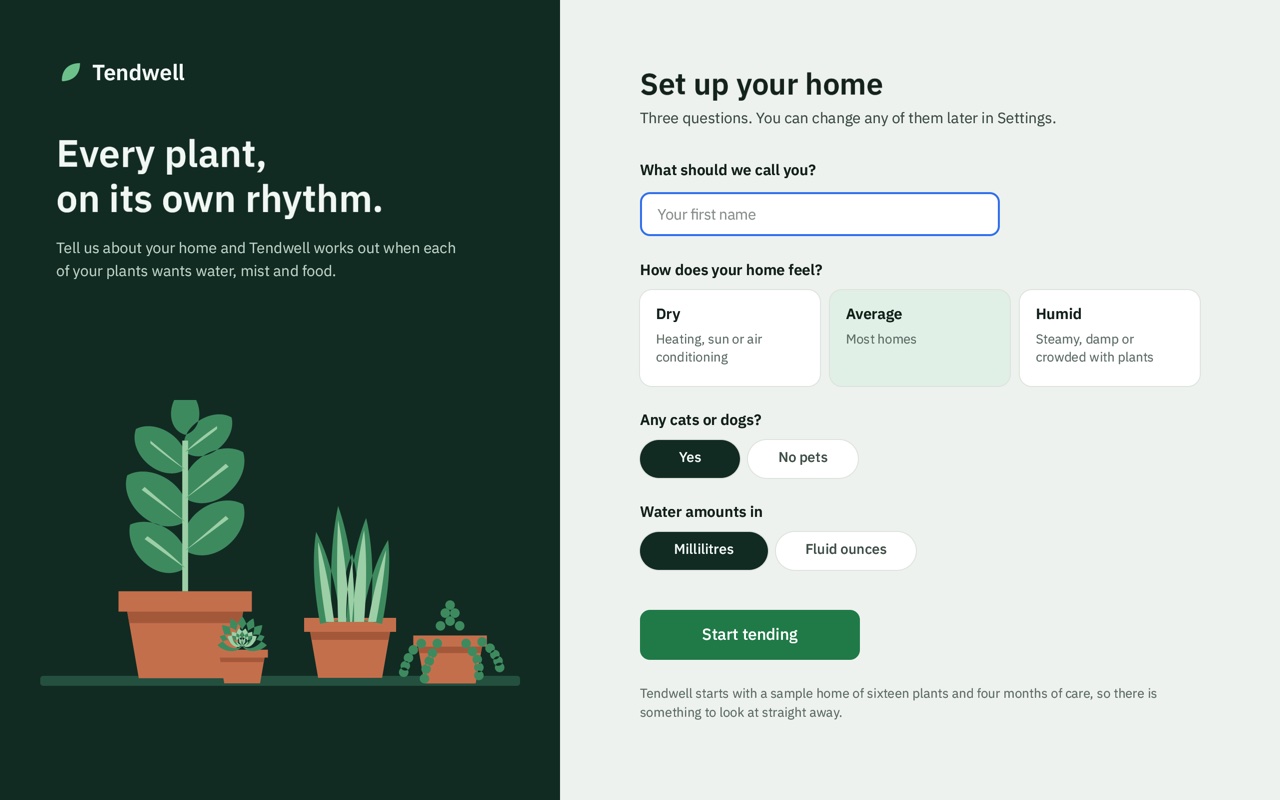
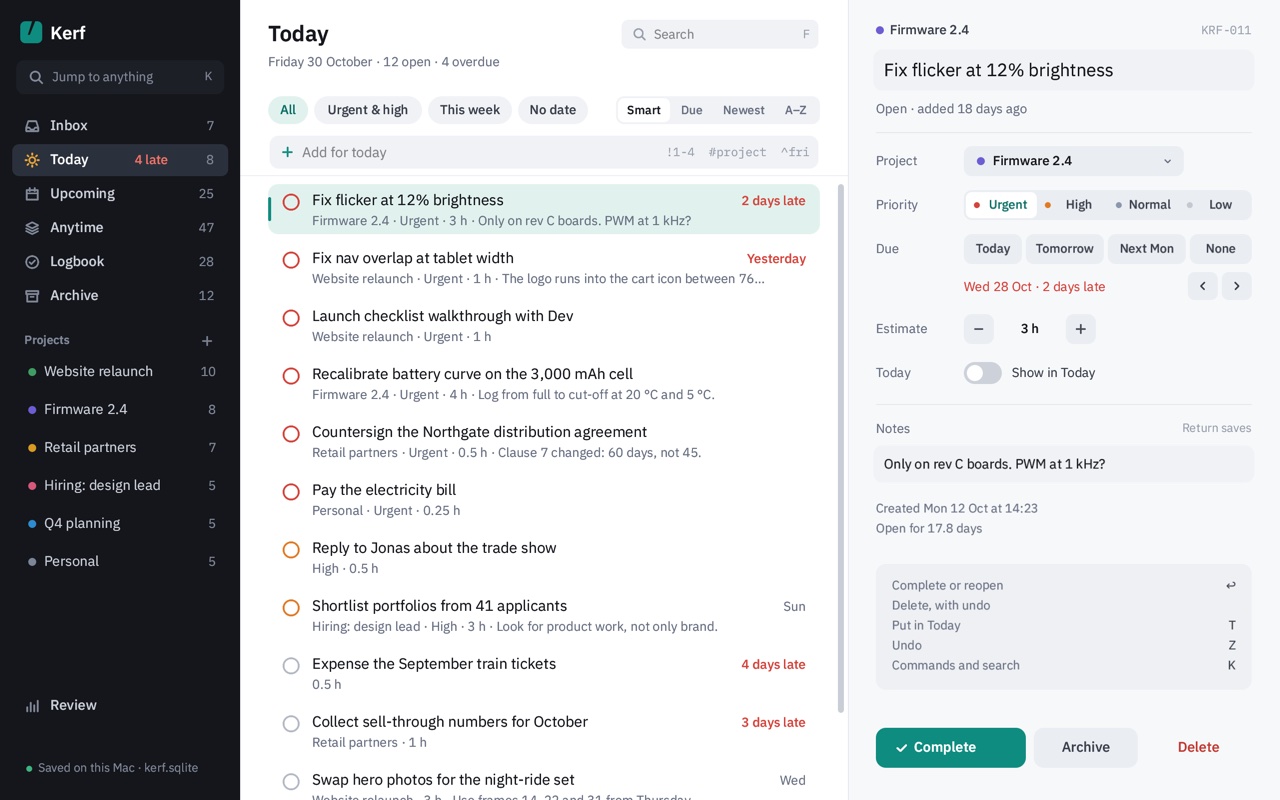
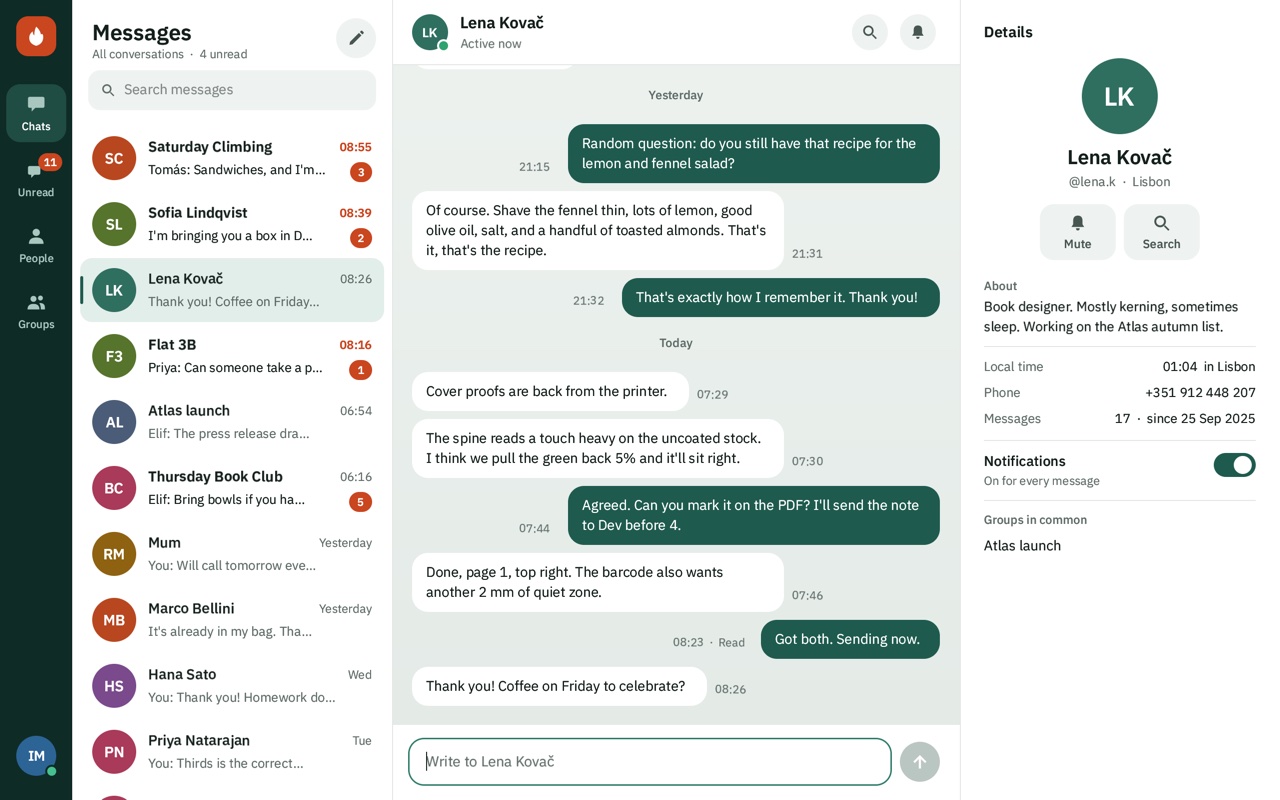
Three agents got the same brief and one category each: Hearthline is a messenger, Kerf manages tasks and projects, Tendwell looks after houseplants. Their data lives in a local database, so an app reopens where you left it.
Open Hearthline in your browser
| App | UI documents | Lines of .abyss | Tables | Web build |
|---|---|---|---|---|
| Hearthline | 13 | 933 | 7 | 4.4 MB |
| Kerf | 18 | 1,216 | 11 | 4.4 MB |
| Tendwell | 27 | 897 | 6 | 4.6 MB |
- How we worked
- Each app is one 1280 × 800 window. Kerf has quick add with typed shorthand (!priority #project ^day), a command palette, filters and sorts, undo and a review of the last two weeks; Tendwell a first-run setup, today's care, plants by room, a species catalogue and a care log; Hearthline unread counts, delivered and read states, a typing indicator, replies that arrive on their own, search and groups.
- What was hard
- Rows in a list must look different from one another: your own bubbles in another colour, a badge that is sometimes gone, an avatar colour each. Until now every row hid a copy of each look. And single-letter shortcuts never reached the flow on macOS.
- What we did
- A row's look now comes from its columns: SELECT a column named bubble:fill and it colours that row's bubble; badge:hidden leaves the badge out. The frame after a press runs the flow's update first, keys carry their modifiers, and single-key shortcuts reach the flow on macOS.
- Still open
- Every colour or text change still re-reads the whole document: by Kerf's own count, 70 of its 80 ms to open. There is no multi-line field and no ellipsis yet.
Onto the web
- How we worked
- The three apps run on the same engine compiled to WebAssembly and sit under /play/ui-pages/ like the last round's pages, about 4.4–4.6 MB each.
- What was hard
- Two problems showed only in a browser. One was caught publishing the last round: what a flow draws in its own update (a fade-in, a pen stroke, a layout from a flag) asked nobody for the next frame, so the picture stood still until the pointer moved; headless tests step their frames and never saw it. The other was Kerf's "⌘K": IBM Plex has no ⌘, and the web's font path refused the whole paragraph, and with it every document it was in, leaving that part of the screen empty.
- What we did
- A flow with an update now keeps the web asking for frames. A character no font has no longer sinks its sentence: it is left blank and the sentence is set as usual (as it already was on a Mac).
- Still open
- The three apps were checked in Chromium on pop-os only, drawn whole; other browsers, phones and tablets are untested.
Three jurors
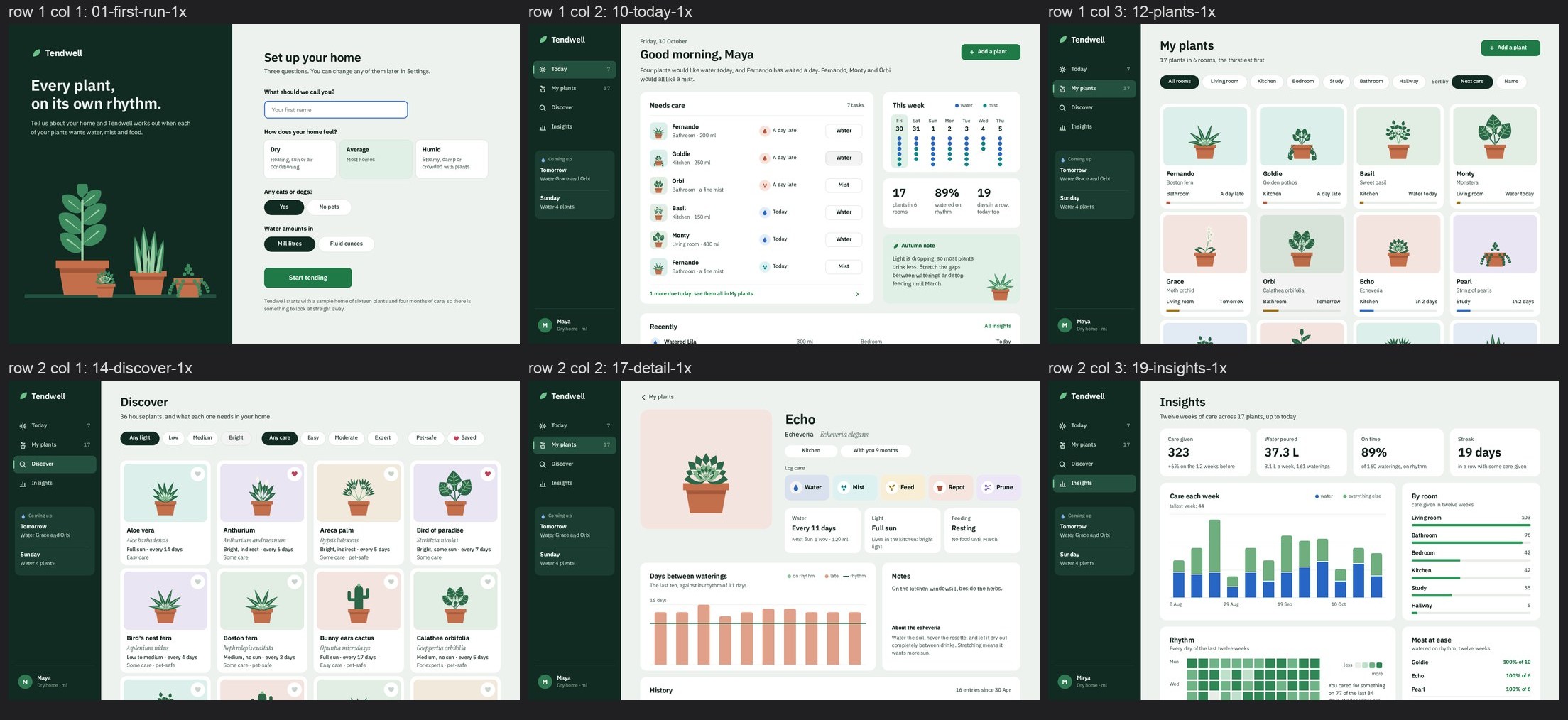
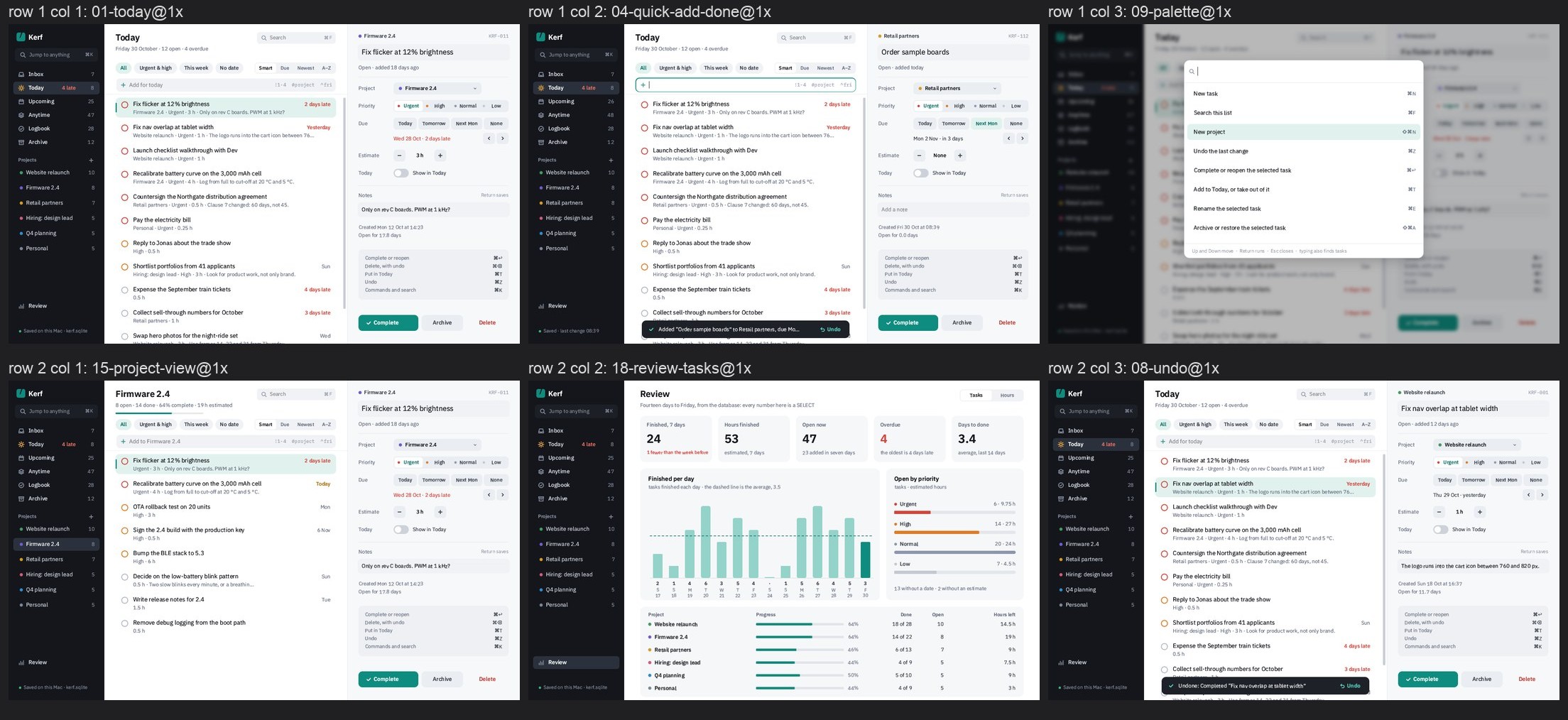
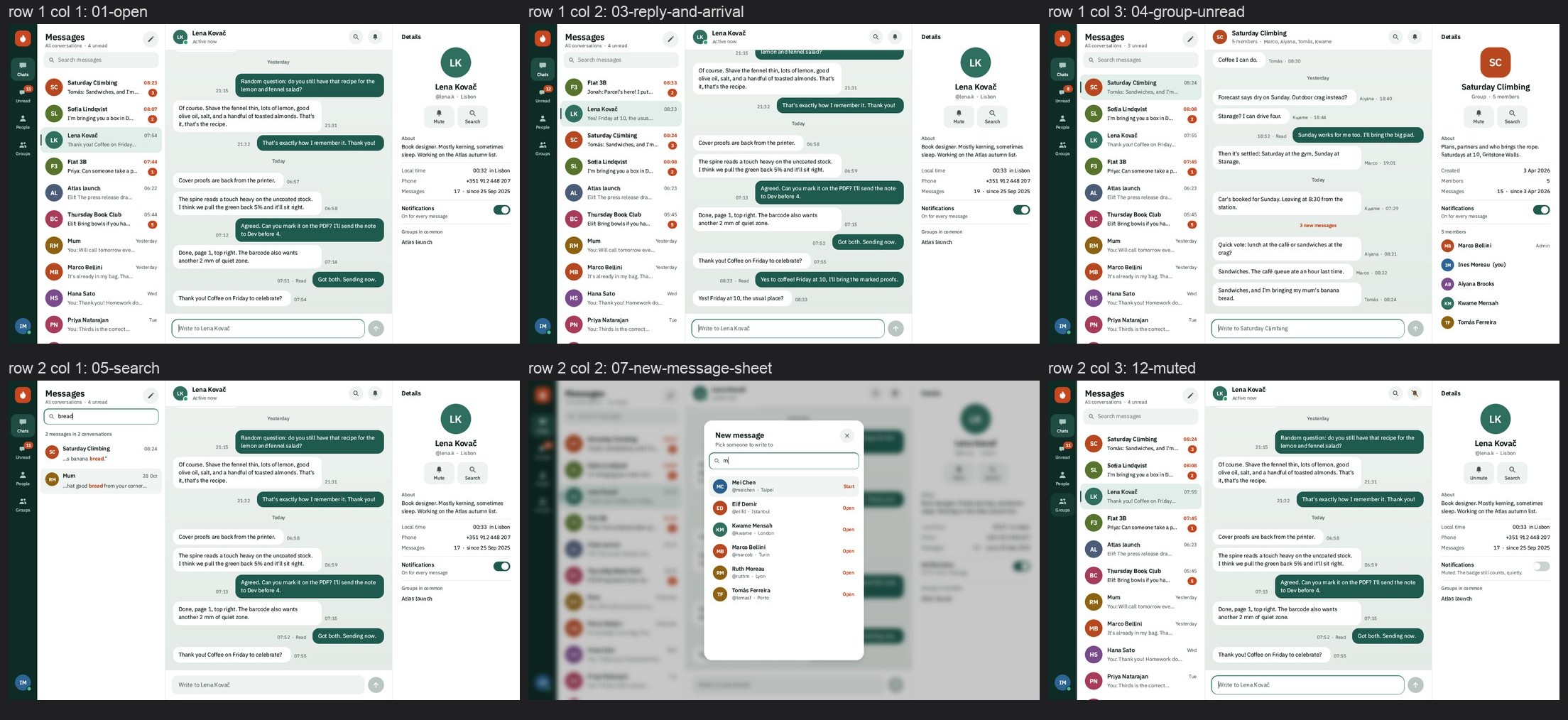
As in the last entry, three independent AI jurors each took one lens: A visual design, B usability, C concept and content. They saw six still moments of each app (the three sheets below) and not who made it or which round it was. Weights follow Awwwards (design 40, usability 30, creativity 20, content 10); 10 is the best of the category today: Things, Todoist and Linear for tasks, Planta and Greg for plants, Telegram and iMessage for messengers.
| App | Mean | A | B | C |
|---|---|---|---|---|
| Tendwell | 7.17 | 7.15 | 7.30 | 7.05 |
| Kerf | 6.83 | 6.95 | 6.65 | 6.90 |
| Hearthline | 6.18 | 6.25 | 6.15 | 6.15 |
- How we worked
- All three jurors put Tendwell first (7.17), then Kerf (6.83) and Hearthline (6.18). Tendwell is the only one with a point of view: each plant on its own rhythm, advice that follows the season, and a Today screen whose sentence turns into one-click actions.
- What was hard
- Tendwell lets one drawing stand for several species, and its sample data disagrees with itself: Echo's ten waterings are all drawn late, yet Insights rates Echo 100% on rhythm. Kerf reads as a careful copy of Things and Linear: after an undo its toast still offers Undo, and its copy shows the build through ("every number here is a SELECT"). Hearthline puts a timestamp on every bubble, makes group senders hard to scan, and has no attachments, emoji or reactions.
- What we did
- There was praise too: every number in Kerf's review agrees with the others, and its keyboard model teaches itself; Hearthline has the best-written conversations, a little world believable down to Lena's local time in Lisbon.
- Still open
- The jurors' shared verdict: competent, consistent, professional-looking work, none of it yet chosen over the leader of its category; the weakness they share is ambition.
Next
First the walls these apps hit: a colour change without re-reading the whole document, a multi-line field, a clock in a package, and an ellipsis. After that, I want the UI to grow toward a desktop system.
Update, October 31: the three apps were rebuilt on a newer engine (d2f4a2ca) and put back on the site, their content unchanged. A fill to one of the document's palette colours no longer re-resolves the whole document; every other edit is checked as before. Cold first frame, measured natively: Kerf 80 → 41 ms, Tendwell 25 → 18 ms, Hearthline 280 → 67 ms (abyss-engine b37b1c61).