Testing the Engine's UI with Award-Style Web Pages
October 27–28: three agents build web pages with the engine alone, where they got stuck, and how reopening a page went from a 739 ms first frame to about 5 ms
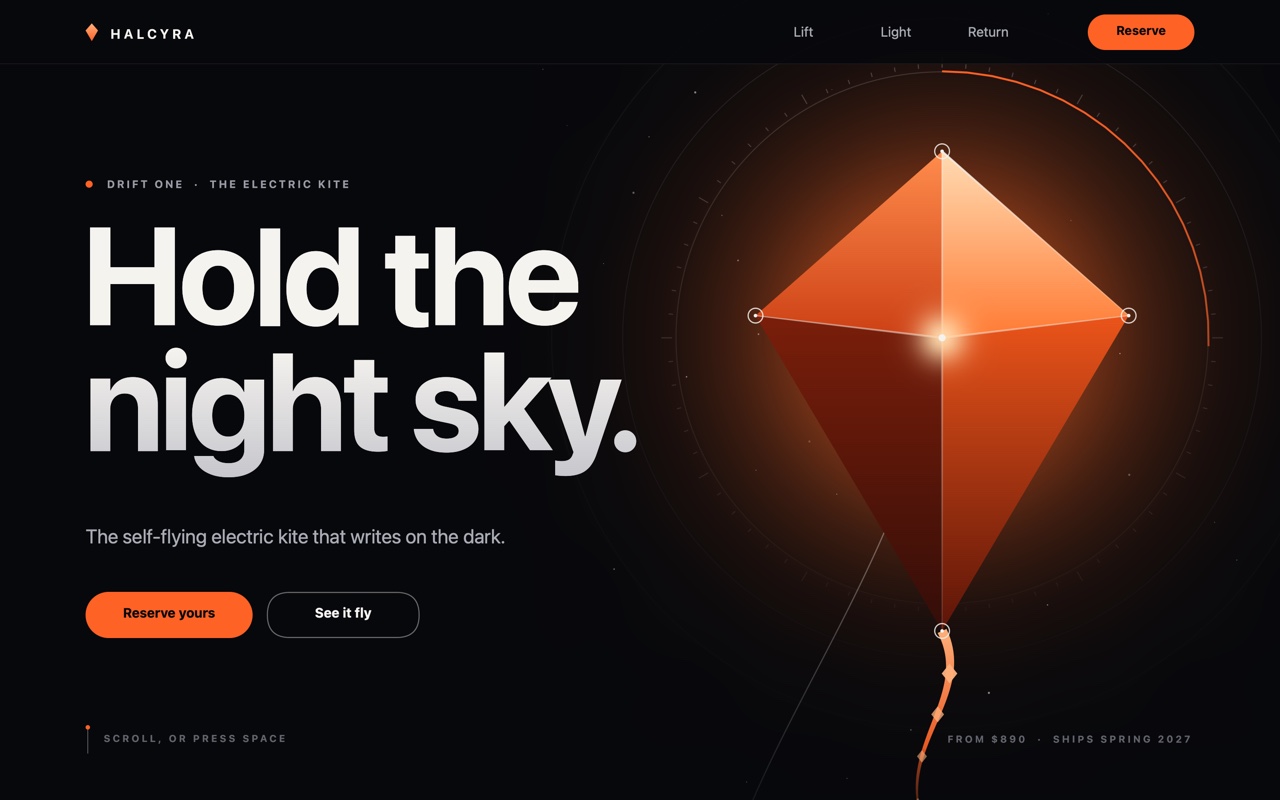
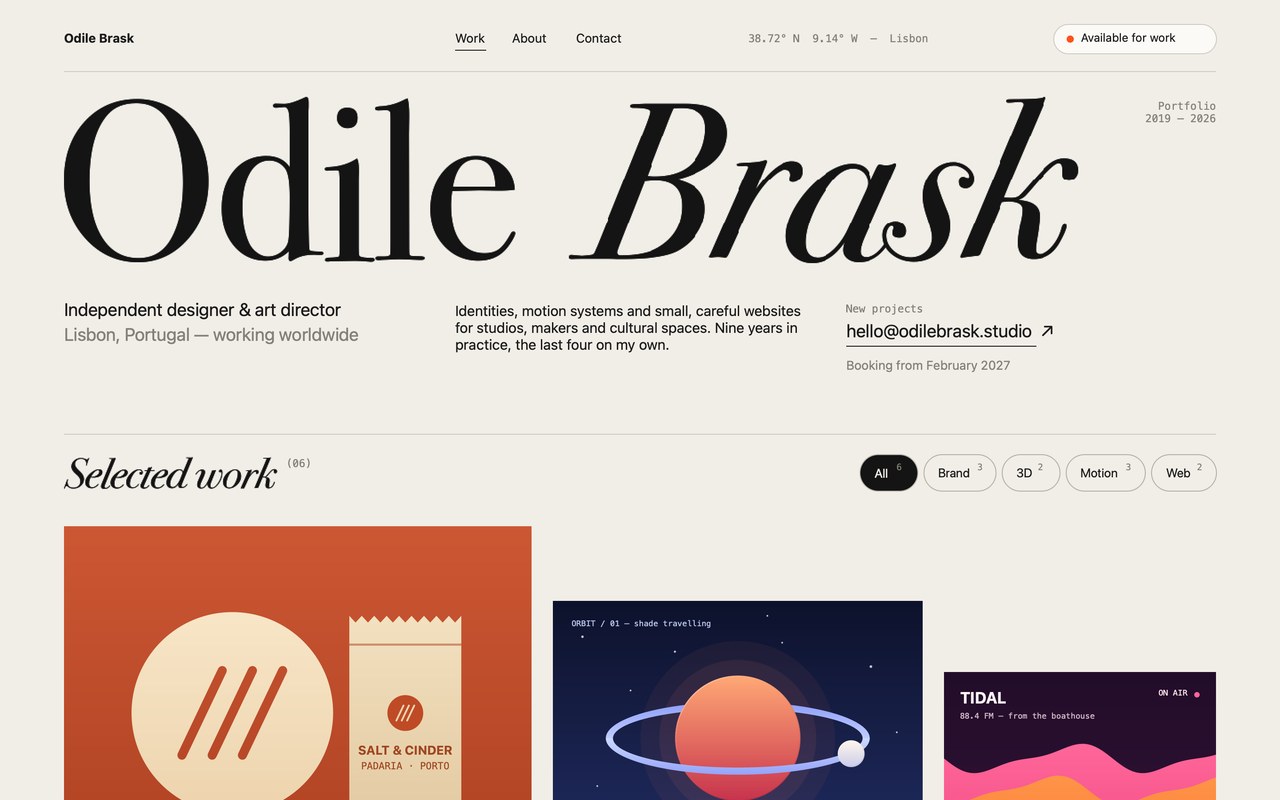
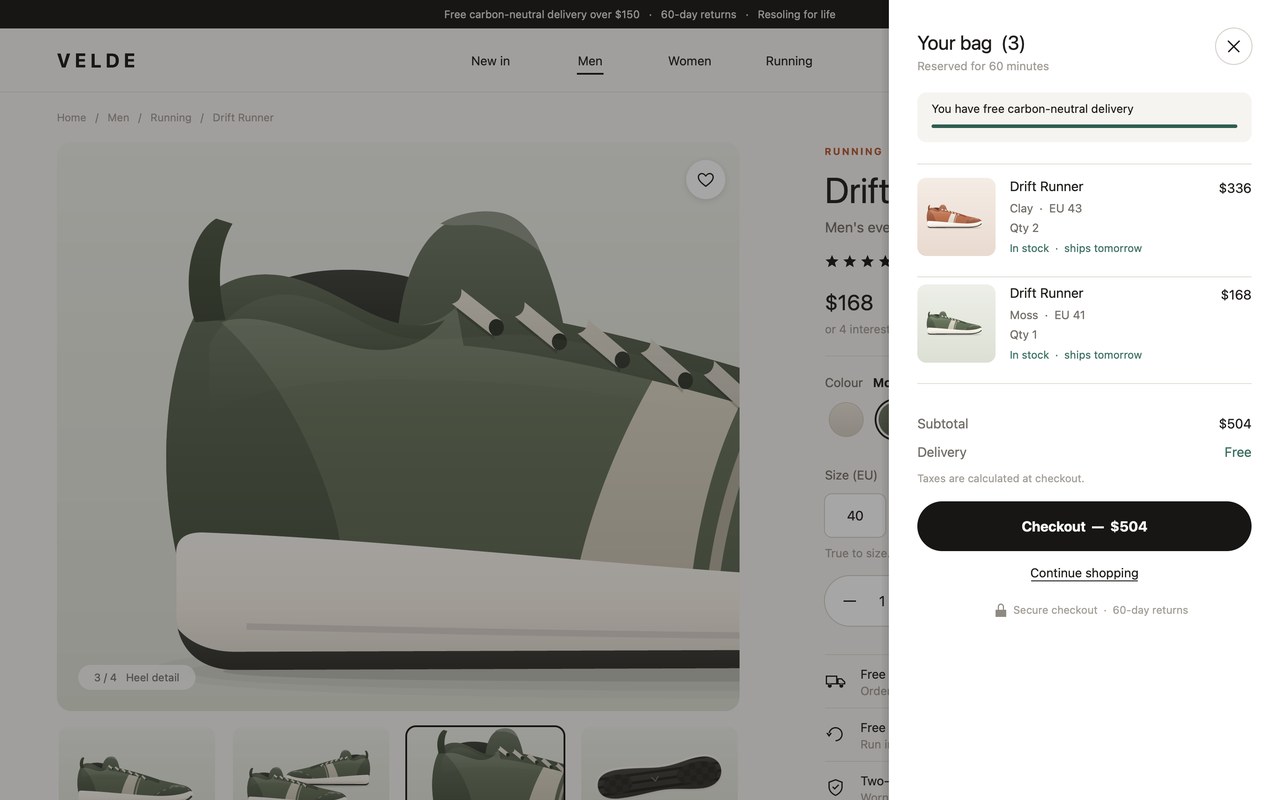
In the last entry, the same engine went into the browser. These two days were about interfaces: the engine's own UI core now owns every interface, and UI Maker steps back to being the authoring tool. To learn what that UI can really do, we took the three kinds of web page that score highest in design awards as an exam, and had three agents build them with nothing but the engine's UI documents, .abyss flows and MCP tools: no C, no window. This entry records what they made, where they got stuck, how we filled those gaps in the engine, and how we finally measured what opening a page costs.
Previous: The Same Town, Now in a Browser →From three trial pages to knowing what opening a page costs
This entry covers the development build as of the evening of October 28. The thread is: trial pages → filling the gaps → typefaces → the flow limits → what opening a page costs → never drawing the same thing twice. All three pages are for fictional brands, and every picture was drawn by the engine headless (no window), with no retouching.
Three award-style pages as an exam
We went through the 31 Awwwards Sites of the Year from 2017 to 2025, the 2025 category awards and the CSS Design Awards 2025 nominations, and found the three kinds of page that score highest: the immersive brand story, the creative portfolio and the premium product page. Judges weigh design about 40%, usability 30%, creativity 20% and content 10%.
- How it works
- Three agents each built one: a 1440-point desktop page for a fictional brand, copying no real site. They could use only the engine's UI documents, .abyss flows and MCP, looking at their pages headless through engine_ui_preview, and at the end scored themselves on the four criteria and reported which documents they read and which limits they hit.
- What was hard
- In the first round they all hit the same wall: a flow could not hear the wheel, keys or the pointer entering, so the immersive page could only scroll by presses and scored its own usability 2. Other walls: only the system typeface, with a style's font field ignored; at most 2048 px per component, so full-width bands had to be drawn in halves; at most 256 flow instructions, about 90 of which the immersive page spent just putting its interfaces in place; error messages that did not say which document failed.
- What we did
- Each gap in their reports became an engine feature rather than something to work around: flows now hear the wheel, keys and enter/leave; a press carries the name of the part it landed on; Return sends submit on every host; a component can ask for the pointing hand; a refusal names its document; a tour fails if any frame was not drawn. In the second round the immersive page's usability rose from 2 to 5 and the portfolio's from 4 to 6.
- Still open
- One document that will not draw still stops the whole page; there is no action to open a URL yet; gradients run only top to bottom; a document is at most 8192 px a side.
| Page | Design | Usability | Creativity | Content |
|---|---|---|---|---|
| Immersive brand page, Halcyra | 5 | 2 → 5 | 4 | 5 |
| Creative portfolio, Odile Brask | 6 | 4 → 6 | 4 | 6 |
| Product page, Velde | 5 | 5 | 3 | 6 |
Letting a style name its typeface
All three agents said the first thing holding their design scores down was type.
- How it works
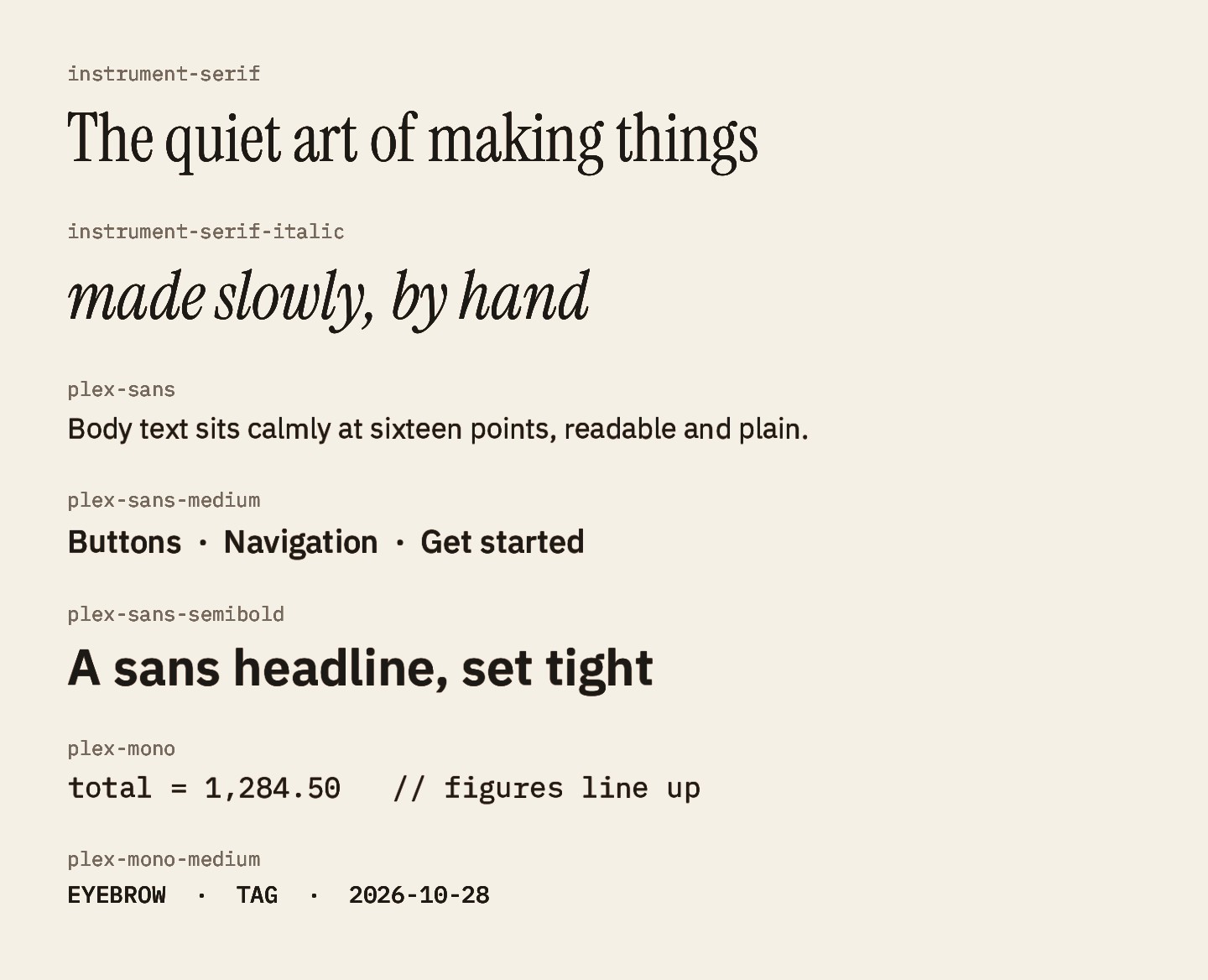
- The engine now ships seven open-licence (SIL OFL) static typefaces: Instrument Serif and its italic for display, IBM Plex Sans in three weights for body text and buttons, and IBM Plex Mono in two weights for figures and labels. Each file is pinned to its source commit and sha256 and kept in the repository with its licence; a style that says "font": "instrument-serif" is set in it, with or without a language catalog.
- What was hard
- On the macOS CoreText path a variable font's named weight cannot be chosen, so only static files are used. The first Linux check "passed everything" while the typeface test never ran at all: that machine's clean checkout lacked the reference face it needed.
- What we did
- The test now uses the same committed font file, so it really runs on Linux too. It checks by measurement: eight Ms and eight is differ by 1 px in Plex Mono and by 123 px in Plex Sans.
- Still open
- All seven are Latin only; a line with Chinese in it is set whole in the face it would have had. UI Maker's art-text preview still uses the system face.
Where did 256 come from?
The three pages' flows used 218 to 242 instructions out of 256, with no room for more. Before raising the limit, we looked up where the number came from.
- How it works
- The git history shows it started at 128 and became 256; on September 19 it was recovered from an old binary's struct layout during a rebuild, never measured. Back then every program carried room for 256 steps whatever its length; since October 1 a program is only as long as it is, so that cost is gone. What remains is a design property: a flow cannot jump backwards, so one run executes at most its compiled instructions and is safe to run every frame. That holds for any limit.
- What was hard
- There is more than one limit: instructions, expression nodes, and the JSON's size and node count are tied together; raise one alone and the next is hit at about 300 instructions.
- What we did
- Measured, a flow of the same length costs the same under the larger limits; a 1024-instruction flow compiles in about 6 ms and runs end to end in about 15 µs. So they moved together: 1024 instructions, 4096 expression nodes, and up to 256 KiB of flow source, while ordinary data objects stay at 64 KiB. The abyssc compiler now reads the runtime's own limits, so the two can no longer disagree.
- Still open
- Precompiling flows into packs would save about 2 ms an open; that waits for release builds.
Where does the time to open a page go?
We assumed complex pages were slow to parse their scripts, so we built a tool that splits opening a page into compiling its flow, mounting its documents and drawing its first frame.
- How it works
- The answer surprised us: compiling the flow takes 1–2 ms, the first frame 70–740 ms. The cost is drawing the documents into pictures on the CPU: the dilation behind outlines and weight, effect compositing and layer blending, all at the window's 2x density.
- What was hard
- These loops are also the heart of the game's art text; Burn the Corn's screens depend on them, so no speed-up may move a single pixel.
- What we did
- First we drew every one of the repository's 683 UI documents plus two trial pages at 1x and 2x and kept the hashes of all 1059 pictures as a baseline, compared again after each change. Only shortcuts that are mathematically the same were taken: no second dilation when there is no outline, no samples weighted zero, clear pixels skipped, fully opaque fills written directly, SVG edges bucketed by row. All 1059 pictures stayed identical, and the immersive page's first frame went from 739 ms to 427 ms.
- Still open
- A first open still has to draw everything; that is the next section.
Never drawing the same thing twice
Opening a page again, previewing after changing one component, reloading during development: each of these used to draw everything from scratch.
- How it works
- A cache keyed by content: a component's picture is kept under the hash of its content, the document's settings, the density and the text configuration, so any change is a new key and nothing stale is shown. Then the parsed and resolved documents were kept too, because each document went text → tree → text about six times in one open. Last came the GPU route: hosts on the same painter share its textures, a reopened page uploads no pixels, and the cache keeps one copy, as textures.
- What was hard
- When a page is larger than the budget and opened again and again, plain LRU pushes out every picture just before it is needed, so nothing is ever taken. Shared GPU textures must also be released before their window closes.
- What we did
- Recently used pictures now stay first; textures are held by count and pinned from the lookup until the painter has them. Each rule counted only once removing it made a test fail. Reopening the immersive page used to cost 739 ms for the first frame alone; opening plus the first frame now takes about 5 ms.
- Still open
- The cache lives within one process; another session or a restart draws from scratch. It is kept in memory and never written to disk. Ironically, the disk problem was ours: during development we had left one screenshot folder per version, 20 GB in all, which we cleared this time too.
| Page | First frame (Oct 28 morning) | First frame (sped up) | Reopen |
|---|---|---|---|
| Immersive brand page, Halcyra | 739 ms | 427 ms | ≈5 ms |
| Creative portfolio, Odile Brask | 67 ms | 40 ms | ≈8 ms |
| The Notes app | 10 ms | 4.9 ms | ≈2.5 ms |
Next: a third round
Most of what stopped the agents last time is now filled in: typefaces, the flow limits, the speed of opening a page. Next, three fresh agents will build the same three kinds of page from the same instructions, to see whether they find these features on their own in the documents and tools, and where the next gaps are.